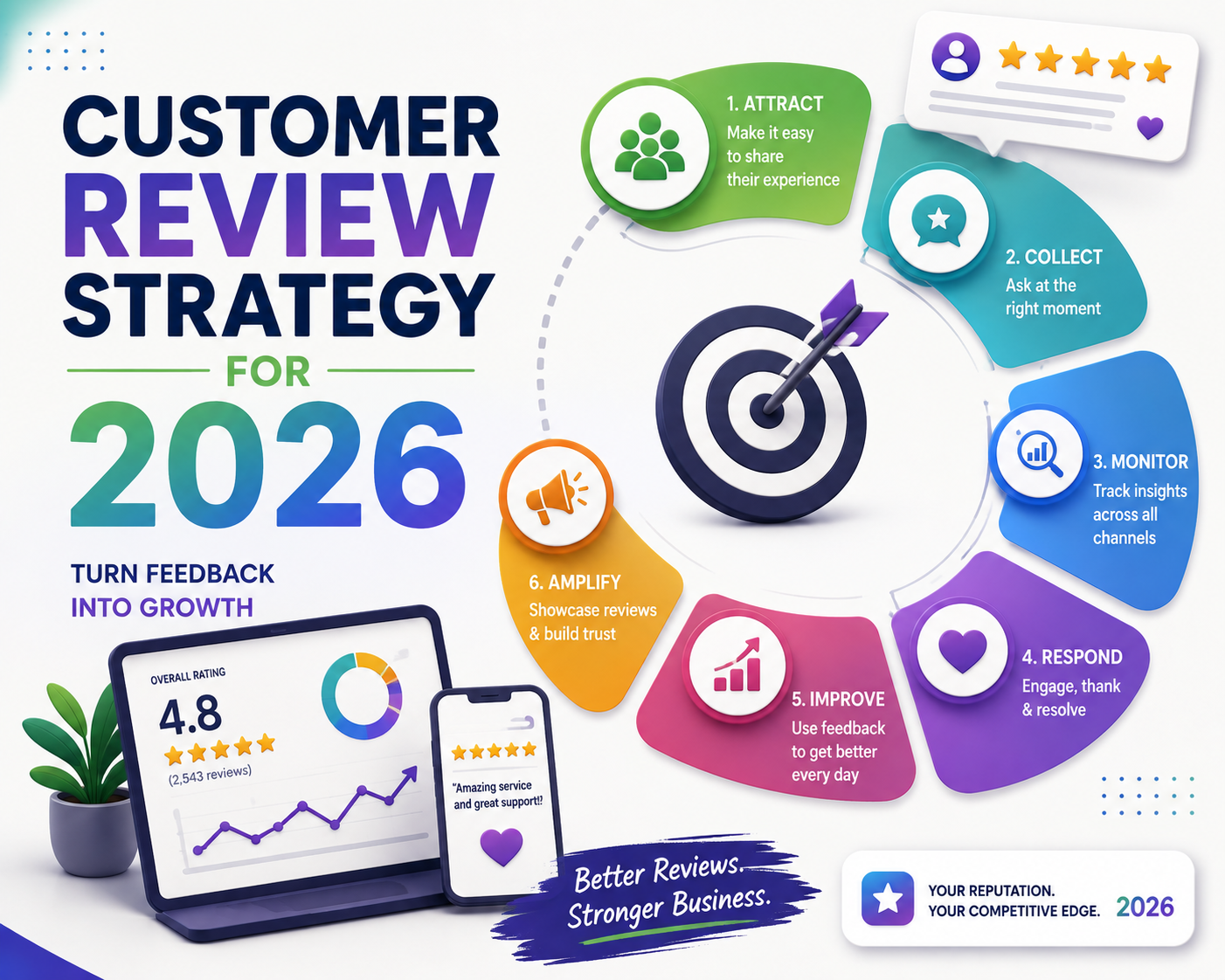
Customer reviews continue to play an important role in how people evaluate businesses online. In 2026, customers have more ways to discover companies, compare alternatives, and research experiences before making a decision.
A strong customer review strategy is therefore not simply about collecting more reviews. Businesses need to think about when they ask for feedback, where customers are likely to share it, how they respond to reviews, and how customer comments can be used to improve the overall experience.
For small businesses and growing brands, a thoughtful review strategy can support trust, customer relationships, and long term reputation.
The most effective approach is built around genuine customer experiences rather than trying to create an artificial appearance of popularity.
What Is a Customer Review Strategy?
A customer review strategy is a structured approach to collecting, monitoring, responding to, and learning from customer feedback.
It can include:
Identifying important review platforms
Creating a review request process
Choosing the right time to ask
Making feedback easy to provide
Monitoring new reviews
Responding to customers
Managing negative feedback
Identifying recurring themes
Using feedback to improve the business
The goal is to create a consistent system rather than asking customers for reviews only when the business needs more feedback.
Why Reviews Matter in 2026
Customers have access to more information than ever.
Before choosing a business, they may compare websites, social profiles, business listings, product information, ratings, and customer experiences.
Reviews can help fill the gap between what a business says about itself and what customers experienced.
A potential customer may want to know:
Was the service reliable?
Was the product as described?
Was customer support helpful?
Was delivery on time?
Was the company professional?
How did the business handle problems?
Reviews can provide answers to these questions.
Start With the Customer Experience
The foundation of any review strategy should be the actual customer experience.
Businesses should not begin by asking how to get more reviews.
Start by asking how to create experiences customers genuinely want to talk about.
Review your customer journey from beginning to end.
Look at:
First contact
Website experience
Ordering
Payment
Delivery
Product use
Customer support
Returns
Follow up
Each stage can affect what customers eventually say about the business.
Identify the Right Review Platforms
Not every business needs to be active on every review website.
Identify where your customers already search for information and where reviews have the most relevance to your industry.
Depending on your business, important platforms may include business listings, industry specific directories, marketplaces, social networks, or dedicated review websites.
Focus on maintaining accurate information and responding consistently on the platforms that matter most.
Keep Business Profiles Updated
Before focusing on review volume, make sure your profiles contain correct information.
Check:
Business name
Website
Phone number
Address
Opening hours
Services
Business description
Images
Incorrect information can create customer frustration and may lead to poor feedback even when the underlying product or service is good.
Build a Review Request Process
Do not depend on employees remembering to ask every customer.
Create a repeatable process.
For example:
Customer completes purchase.
Customer receives the product or service.
Business confirms the experience.
Customer receives an invitation to share honest feedback.
The review is monitored.
The business responds when appropriate.
Feedback is analyzed.
A simple process makes review management easier to maintain.
Ask at the Right Time
Timing can affect the quality of customer feedback.
Ask after the customer has had enough time to form an opinion.
For a restaurant, the appropriate moment may be shortly after the visit.
For an online store, it may be after delivery.
For a service provider, it may be after the project is completed.
For a software company, it may be after the customer has used the product long enough to understand its value.
The best timing depends on the customer journey.
Ask for Honest Feedback
Your review request should invite genuine opinions.
Instead of:
“Please give us five stars.”
try:
“We would appreciate your honest feedback about your experience.”
This gives customers the freedom to describe what they actually experienced.
It also helps businesses receive more useful information.
Make Review Requests Easy
Customers are busy.
A complicated process can reduce participation.
Keep requests short.
Provide clear instructions.
Where appropriate, give customers a simple path to the relevant review page.
Avoid unnecessary forms and complicated steps.
The easier the process, the less effort customers need to invest.
Use Different Communication Channels
Review requests can be delivered through different channels depending on your customer journey.
Options may include:
SMS
Post purchase messages
Customer support follow ups
In person requests
Website prompts
Choose channels that customers already use to communicate with your business.
Avoid sending review requests through channels that customers have not agreed to receive communications from.
Personalize Review Requests
A generic message can feel automated.
Where practical, personalize the request based on the customer’s interaction.
For example:
“Thank you for choosing our team for your recent project. We hope everything went smoothly. We would appreciate hearing about your experience.”
The message feels more connected to the customer’s actual interaction.
Do Not Pressure Customers
Review requests should remain voluntary.
Do not make customers feel that they owe the business a positive rating.
Avoid repeatedly contacting customers who have already declined.
A respectful approach protects the customer relationship.
Let Customers Use Their Own Words
Businesses should not write reviews for customers.
You can ask customers to describe what they liked or what could be improved, but the final feedback should reflect their own experience.
Authentic customer language can provide more useful information than carefully scripted comments.
Create a Balanced Review Profile
A trustworthy review profile does not need to look perfect.
Real businesses can receive criticism.
Customers understand that no company delivers a flawless experience every time.
What matters is the overall pattern and how the business responds.
A balanced profile with genuine feedback can provide more credibility than a collection of overly polished comments.
Respond to Positive Reviews
Thank customers who take the time to leave positive feedback.
Try to mention something specific from their review.
For example:
“Thank you for your kind feedback. We are glad you found our ordering process simple and convenient.”
This shows that the business actually read the review.
Respond to Negative Reviews Professionally
Negative reviews require extra care.
Do not respond while angry.
Read the complaint carefully.
Check the facts.
Acknowledge the customer’s concern.
Apologize when appropriate.
Offer a reasonable next step.
Avoid revealing private information.
If the issue is legitimate, investigate it and improve the underlying process.
Do Not Argue With Customers Publicly
A public argument can make a small complaint appear much bigger.
Even when you disagree with a customer, remain professional.
Potential customers may be watching the conversation.
They are evaluating not only the original complaint but also how your business handles disagreement.
Use Negative Feedback as Business Information
Negative reviews can reveal recurring problems.
Create categories for complaints such as:
Delivery
Product quality
Communication
Customer support
Pricing
Booking
Website usability
Staff behavior
Then identify patterns.
If several customers mention the same problem, investigate it.
Track Positive Feedback Too
Businesses often focus heavily on complaints.
Positive feedback can be equally useful.
If customers repeatedly praise:
Fast responses
Friendly staff
Reliable delivery
Product quality
Easy ordering
Professional service
then you have evidence of what your business does well.
Protect these strengths as the company grows.
Monitor Review Activity Regularly
Review management should be ongoing.
Check important platforms regularly for:
New reviews
Customer questions
Negative feedback
Unanswered comments
Changes in rating
Recurring complaints
Positive trends
The frequency of monitoring depends on how much review activity your business receives.
Measure More Than Your Average Rating
A star rating is useful, but it is not the entire picture.
Track:
Number of new reviews
Review recency
Response rate
Common complaints
Common compliments
Customer sentiment
Changes over time
These measures provide a better understanding of reputation.
Look at Review Trends
One review may not tell you much.
A pattern across many reviews can reveal something important.
For example, if customers start complaining about slower delivery after a process change, the timing may help identify the cause.
Similarly, if positive feedback increases after staff training, the change may have contributed to a better experience.
Look for patterns instead of reacting to every individual comment.
Use Reviews to Improve Products and Services
Customer feedback can influence business decisions.
Reviews may reveal:
Missing features
Quality problems
Confusing instructions
Popular products
Common service requests
Customer expectations
Improvement opportunities
Share relevant insights with the teams responsible for making changes.
Connect Reviews With Customer Service
Review management should not operate separately from customer service.
When a review reveals a problem, the information should reach the people who can address it.
Customer service teams can also identify recurring issues before they become widespread public complaints.
This creates a feedback loop:
Customer experience
Customer feedback
Business analysis
Improvement
Better customer experience
More useful feedback
Be Careful With Review Incentives
Some businesses consider offering rewards for reviews.
Before using incentives, check the policies of the relevant platform and applicable regulations.
Never make an incentive dependent on a positive rating.
The purpose should be to encourage genuine feedback, not manipulate customer opinions.
Avoid Fake Reviews
Artificial reviews can create significant reputation risks.
A strong review strategy should focus on genuine customers and genuine experiences.
Fake feedback can make a profile look stronger temporarily, but if customers or platforms discover manipulation, the resulting loss of trust can be difficult to repair.
Authenticity should remain a central part of your review strategy.
Do Not Try to Make Every Review Positive
A business does not need to eliminate every negative comment.
Instead, focus on improving the overall customer experience.
When criticism appears, ask whether it reveals something that needs to change.
A business that responds responsibly to problems can still build a strong reputation.
Use Customer Feedback in Marketing Carefully
Genuine customer feedback can provide useful insights for marketing.
Customer language can help businesses understand which benefits matter most to their audience.
However, businesses should not distort or rewrite customer comments in a way that changes their meaning.
Respect the original context and applicable permissions when using customer feedback publicly.
Create a Review Management Calendar
A simple calendar can help keep reputation work consistent.
For example:
Monday: Check important review platforms
Wednesday: Review unresolved customer concerns
Friday: Analyze recurring feedback
Monthly: Review rating and review trends
Quarterly: Evaluate the overall customer feedback process
The exact schedule can be adjusted based on review volume.
Train Your Team
Employees should understand how customer feedback affects the business.
Train staff on:
When review requests are appropriate
How to communicate naturally
How to handle complaints
When to escalate an issue
What information should remain private
How to respond professionally
Good training helps create consistency across customer interactions.
Create Clear Escalation Rules
Some reviews require more attention than others.
A routine compliment may only require a thank you.
A serious complaint involving safety, payment, privacy, or another significant issue may need immediate escalation.
Create internal rules so employees know when management or another specialist should become involved.
Improve Your Strategy Over Time
Your review strategy should evolve as your business changes.
Monitor what works.
If customers respond better to one communication channel, consider focusing more on it.
If certain questions produce useful feedback, keep them.
If customers find a process confusing, simplify it.
Small improvements can make the system more efficient over time.
A Simple Customer Review Strategy for 2026
Businesses looking for a practical starting point can follow this framework.
First, improve the customer experience.
Second, identify the review platforms that matter.
Third, keep business profiles accurate.
Fourth, create a consistent review request process.
Fifth, ask customers for honest feedback at an appropriate time.
Sixth, make the process easy.
Seventh, respond professionally to positive and negative reviews.
Eighth, monitor recurring themes.
Ninth, share useful insights with the team.
Tenth, use customer feedback to improve the business.
This creates a sustainable system rather than a short term review campaign.
Final Thoughts
A customer review strategy for 2026 should be built around trust, consistency, and genuine customer experiences.
Businesses should move beyond simply asking how to increase their review count.
The more important questions are:
Are customers receiving a good experience?
Are they being given an easy way to share honest feedback?
Is the business listening?
Are recurring problems being fixed?
Are positive customer experiences being recognized?
A strong review strategy connects all of these areas.
Reviews can influence how customers evaluate a business, but their greatest value comes from what they teach the business about its customers.
By creating a consistent process for collecting, monitoring, responding to, and learning from feedback, businesses can build a more credible reputation and make customer experience a stronger part of their long term growth strategy.
Frequently Asked Questions
What is the best customer review strategy for 2026?
The best strategy is to focus on genuine customer experiences, request honest feedback at appropriate times, make reviews easy to provide, respond professionally, and use feedback to improve the business.
How can I get more customer reviews in 2026?
Create a consistent review request process and invite customers to share honest feedback after they have experienced your product or service.
Should I ask customers for five star reviews?
It is better to ask customers for honest feedback rather than requesting a specific rating. This keeps the process more authentic.
When should I ask for a customer review?
Ask after the customer has had enough time to experience your product or service. The appropriate timing depends on the type of business.
How can I make review requests easier?
Keep the message short, provide clear instructions, and use a convenient path to the relevant review platform when appropriate.
Should businesses respond to every review?
Businesses should aim to respond consistently, especially to detailed reviews and customer concerns. The exact approach can depend on review volume.
How should I respond to a negative review?
Stay professional, acknowledge the concern, check the facts, offer a reasonable next step, and avoid sharing private information publicly.
Can negative reviews be useful?
Yes. They can identify recurring problems and provide opportunities to improve products, services, communication, or customer support.
Are fake reviews a good reputation strategy?
No. Artificial reviews can create trust problems and may violate platform policies or applicable rules. Genuine customer feedback provides a more sustainable foundation.
Should I use multiple review platforms?
Use platforms that are relevant to your customers and industry. Maintaining a few important profiles properly is generally more useful than spreading resources across every available platform.
How often should I monitor customer reviews?
The ideal frequency depends on review volume. Businesses with frequent customer activity may need to monitor reviews more often than businesses that receive only occasional feedback.
What should I track besides my star rating?
Track review volume, recent feedback, response activity, recurring complaints, recurring compliments, and changes in customer sentiment.
Can reviews help improve customer service?
Yes. Reviews can reveal what customers appreciate and where service processes may need improvement.
Should I offer incentives for reviews?
Check the policies of the relevant platform and applicable regulations first. Never make an incentive dependent on leaving a positive review.
How long does it take to build a strong review profile?
There is no fixed timeline. A credible review profile develops through consistent customer experiences, genuine feedback, professional responses, and continuous improvement.

Leave a Reply