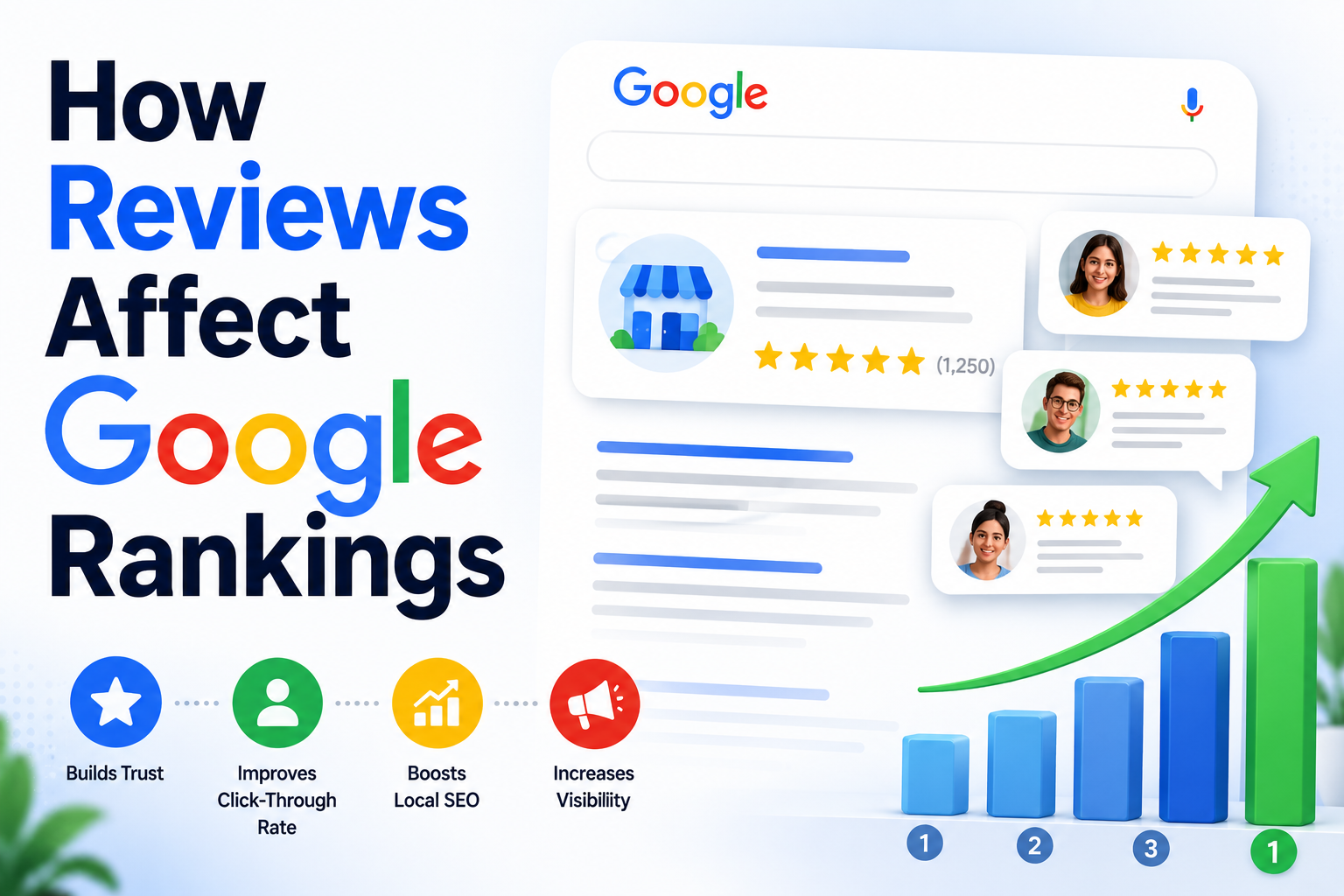
Online reviews are one of the most important trust signals for businesses. When people search for a product, service, restaurant, clinic, hotel, or local company, they often look at reviews before making a decision. Reviews help customers understand whether a business is reliable, active, and trusted by others.
But reviews do not only influence customers. They can also affect how a business appears in Google Search and Google Maps. For local businesses especially, reviews can play an important role in visibility, clicks, and customer actions.
In this article, we will explain how reviews affect Google rankings, why they matter for SEO, and how businesses can improve their review profile in a safe and ethical way.
What Are Google Rankings?
Google rankings refer to the position of a website or business listing in Google Search results. If your business appears near the top, more people are likely to see it and click on it. If it appears lower, fewer people may notice it.
For local businesses, rankings can also refer to visibility in Google Maps and the local pack. The local pack is the group of business listings that appears when someone searches for services near them, such as “dentist near me” or “best salon in Chennai.”
Higher rankings can bring more website visits, phone calls, direction requests, bookings, and sales.
Why Reviews Matter To Google
Google wants to show helpful and trustworthy results to users. Reviews help Google understand how customers feel about a business. They provide signals about customer satisfaction, service quality, relevance, and trust.
For example, if many customers leave detailed positive reviews about a restaurant’s food, service, and location, Google may better understand what the restaurant is known for.
Reviews can also show whether a business is active and engaging with customers. A business with recent reviews may look more active than one with no new reviews for years.
Do Reviews Directly Affect Rankings?
Reviews can influence local search rankings, especially for Google Business Profiles. Google has stated that review count and review score can factor into local search ranking. This means businesses with more positive and high-quality reviews may have better chances of appearing in local results.
However, reviews are not the only ranking factor. Google also looks at relevance, distance, and prominence. This means a business must match the search, be located near the searcher or target area, and have strong overall online authority.
So, reviews help, but they are only one part of the ranking system.
The Three Main Local Ranking Factors
Google local rankings are mainly influenced by three factors: relevance, distance, and prominence.
1. Relevance
Relevance means how well your business matches what the user is searching for. If someone searches for “emergency plumber,” Google wants to show businesses that clearly offer emergency plumbing services.
Reviews can support relevance when customers mention your services, products, or location naturally.
2. Distance
Distance means how close your business is to the searcher or the location used in the search. If someone searches “coffee shop near me,” Google may show nearby coffee shops first.
Reviews cannot change your physical location, but they can help your business stand out among nearby competitors.
3. Prominence
Prominence means how well-known and trusted your business is online. Reviews, ratings, links, directories, articles, and overall online presence can all support prominence.
A business with many genuine reviews and strong online mentions may appear more prominent than a business with little online activity.
At a Glance
| Review Factor | How It Can Help Rankings |
|---|---|
| Review quantity | Shows customer activity and popularity |
| Review quality | Builds trust and improves click confidence |
| Review rating | Higher ratings may attract more clicks |
| Review freshness | Shows the business is active |
| Review keywords | Helps Google understand services |
| Owner responses | Shows engagement and customer care |
Review Quantity
The number of reviews can affect how users and search engines see a business. A business with many genuine reviews may appear more established than one with only a few.
For example, if two similar businesses are near the same location, the one with more positive and recent reviews may look more trustworthy to users.
However, quantity alone is not enough. A business should focus on genuine reviews from real customers, not fake or paid reviews.
Review Quality
Review quality matters because detailed reviews are more useful than short or vague ones. A review that says “Good service” is helpful, but a review that explains the service, staff behavior, product quality, and experience gives more context.
Detailed reviews can include natural keywords that help Google understand what your business offers.
For example:
“The team repaired my AC quickly and explained the issue clearly.”
This review tells Google and users that the business provides AC repair services.
Review Rating
Star ratings affect customer trust. A higher rating can improve click-through rates because users are more likely to choose businesses with better ratings.
If your business has a strong rating, people may click your listing more often. More engagement can support overall visibility.
But a perfect 5-star rating is not always necessary. Many customers trust businesses with balanced and genuine reviews more than profiles that look artificially perfect.
Review Freshness
Recent reviews show that a business is active. If your last review is from three years ago, users may wonder whether the business is still operating or whether service quality has changed.
Fresh reviews help keep your Google Business Profile active and relevant. Businesses should encourage regular honest reviews instead of collecting many reviews at once and then stopping.
Keywords In Reviews
Customers often mention services, products, locations, and experiences in reviews. These natural keywords can help Google understand your business better.
For example, reviews may mention:
- “best wedding photographer”
- “quick laptop repair”
- “affordable dental clinic”
- “friendly staff”
- “same-day delivery”
- “near the metro station”
These words can support relevance, but businesses should not tell customers exactly what to write. Reviews should be natural and honest.
Owner Responses To Reviews
Responding to reviews can help build trust. It shows that the business cares about customer feedback.
Owner responses may not directly guarantee higher rankings, but they can improve customer confidence and engagement. A professional response to both positive and negative reviews can make your business look active and responsible.
When replying, use a natural tone. Avoid stuffing keywords into responses.
Negative Reviews And Rankings
Negative reviews can affect user trust and may reduce clicks. If many people see poor ratings or repeated complaints, they may choose a competitor.
A few negative reviews do not automatically destroy rankings. In fact, a natural review profile often includes some mixed feedback. What matters is how the business responds and whether the overall rating remains strong.
If negative reviews mention the same problem repeatedly, the business should fix the issue.
Fake Reviews And Ranking Risk
Fake reviews can harm a business. Google does not allow fake engagement, review manipulation, or incentivized reviews. If Google detects fake reviews, it may remove them or take action against the business profile.
Buying reviews or asking people to leave dishonest feedback is risky. It can damage trust and violate Google policies.
The best approach is to collect genuine reviews from real customers.
How To Get More Genuine Reviews
Businesses can improve their review profile by asking satisfied customers for honest feedback.
Good ways to request reviews include:
- Ask after a successful service
- Send a review link by email or message
- Add a review request to receipts
- Train staff to ask politely
- Make the process simple
- Respond to existing reviews
- Never pressure customers
- Never offer rewards for positive reviews
The goal is not to force positive reviews. The goal is to encourage real customers to share honest experiences.
How To Respond To Reviews
Responding well can improve brand image.
For positive reviews, thank the customer and keep the reply personal.
Example:
“Thank you for your kind feedback. We are happy to know you had a good experience with our team.”
For negative reviews, stay calm and helpful.
Example:
“Thank you for sharing your feedback. We are sorry your experience did not meet expectations. Please contact our support team so we can review this and help resolve the issue.”
A professional response can reduce the impact of negative feedback.
Common Review Mistakes To Avoid
Businesses should avoid review practices that can harm rankings and reputation.
Do not:
- Buy fake reviews
- Ask only happy customers in a misleading way
- Offer gifts for positive reviews
- Write reviews for your own business
- Ask employees to post fake reviews
- Ignore negative reviews
- Argue with customers publicly
- Use keyword-stuffed replies
- Report every negative review without reason
These mistakes can damage trust and may violate platform rules.
Reviews And Click-Through Rate
Reviews can improve click-through rate because users often compare ratings before clicking. A business with strong reviews may receive more clicks than a business with weak or no reviews.
More clicks can lead to more calls, website visits, bookings, and direction requests. This is why reviews are important not only for rankings but also for conversions.
Reviews And Google Maps
Reviews are especially important for Google Maps. When users search for local services, they often compare star ratings, review count, photos, location, and business details.
A well-maintained Google Business Profile with strong reviews can perform better in local searches and map results.
Make sure your profile includes accurate business hours, services, photos, contact details, and categories.
FAQs
1. Do Google reviews help rankings?
Yes, reviews can help local rankings. Google considers review count and review score as part of local search visibility, along with relevance, distance, and prominence.
2. Are more reviews always better?
More reviews can help, but they must be genuine. Quality, freshness, rating, and detail also matter.
3. Can negative reviews hurt rankings?
A few negative reviews may not directly hurt rankings, but many poor reviews can reduce trust, clicks, and customer actions.
4. Should I use keywords in review replies?
Use natural language only. Do not stuff keywords into replies. Focus on helpful and professional responses.
5. Is it okay to buy Google reviews?
No. Buying reviews violates Google policies and can harm your business profile and reputation.
Final Thoughts
Reviews can affect Google rankings, especially for local businesses. They help Google and customers understand trust, relevance, activity, and service quality. Review quantity, rating, freshness, detail, and owner responses can all influence how people interact with your business online.
However, reviews are only one part of SEO. Businesses should also focus on accurate Google Business Profile details, strong website content, local SEO, good customer service, and consistent online presence.
The safest way to improve rankings is to earn genuine reviews from real customers, respond professionally, and use feedback to improve your business.

Leave a Reply