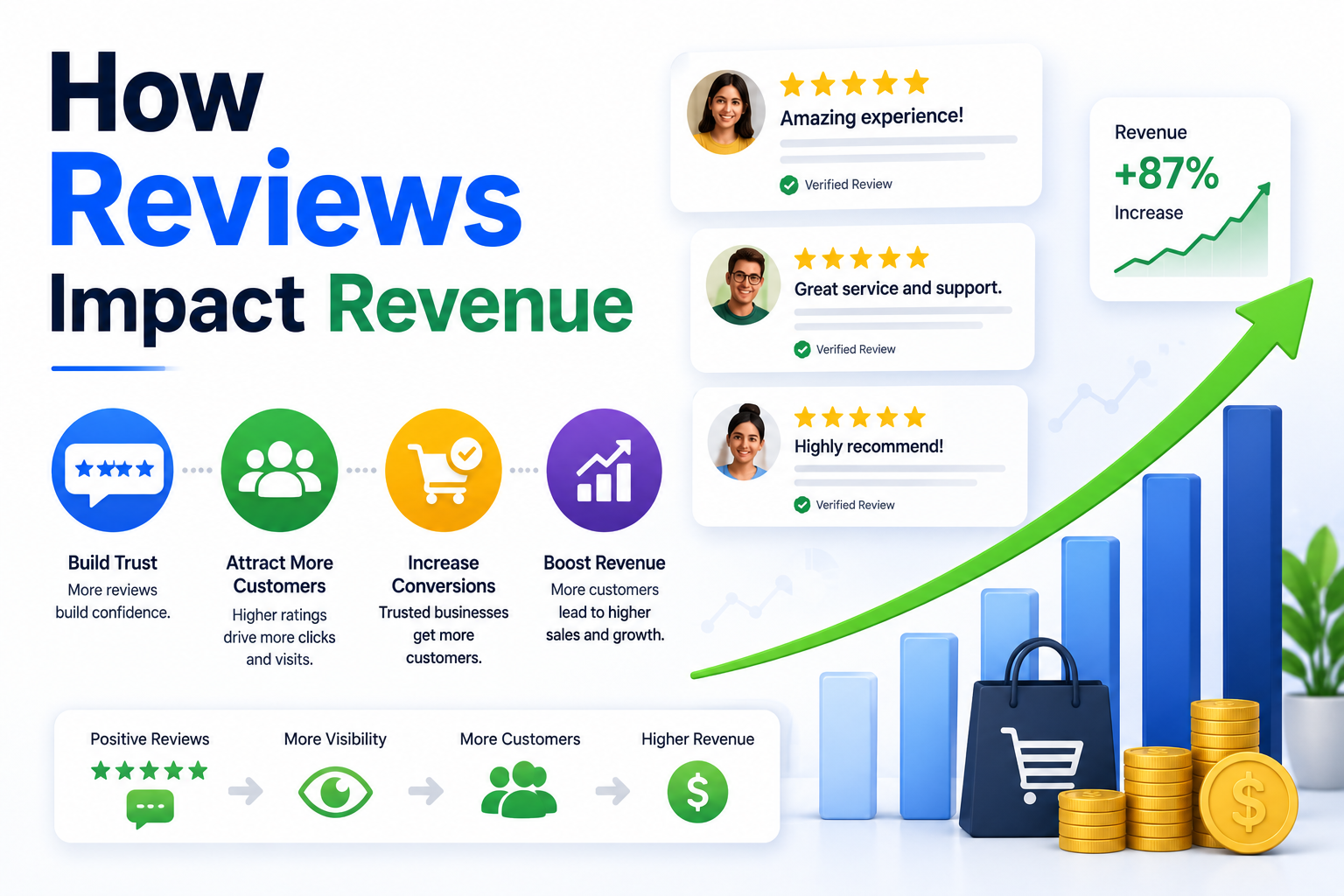
Online reviews have become one of the strongest factors in customer decision-making. Before buying a product, booking a service, visiting a restaurant, choosing a hotel, or hiring a company, many people read reviews first. Reviews help customers decide whether a business is trustworthy, reliable, and worth their money.
Because reviews influence trust, they also influence revenue. A strong review profile can increase sales, bookings, calls, and enquiries. Poor reviews can reduce conversions and push customers toward competitors.
In this article, we will explain how reviews impact revenue, why they matter, and how businesses can use reviews to grow.
Why Reviews Matter For Revenue
Revenue depends on customer confidence. If people trust a business, they are more likely to buy from it. Reviews act as social proof. They show that other customers have already used the product or service and shared their experience.
For example, if two businesses offer the same service at a similar price, customers may choose the one with better reviews. A business with strong reviews feels safer. A business with poor reviews feels risky.
Reviews can influence revenue by affecting:
- Clicks
- Calls
- Website visits
- Store visits
- Bookings
- Purchases
- Repeat customers
- Referrals
- Brand trust
This makes reviews an important part of business growth.
How Positive Reviews Increase Revenue
Positive reviews can help a business earn more by increasing customer trust. When people see good ratings and detailed feedback, they feel more confident about choosing the business.
Positive reviews can:
- Increase conversion rates
- Improve click-through rates
- Bring more local customers
- Reduce customer hesitation
- Support premium pricing
- Improve brand image
- Encourage repeat purchases
- Increase referrals
A positive review can work like a recommendation from another customer. This is powerful because people often trust customer opinions more than advertisements.
How Negative Reviews Reduce Revenue
Negative reviews can create doubt. If customers see repeated complaints about poor service, delays, rude staff, low quality, or refund issues, they may choose another business.
Negative reviews can reduce revenue by:
- Lowering trust
- Reducing calls and enquiries
- Decreasing website conversions
- Increasing customer hesitation
- Damaging brand reputation
- Lowering star ratings
- Increasing refund concerns
- Pushing customers to competitors
A few negative reviews may not destroy a business, especially if the business responds well. But many negative reviews or repeated complaints can seriously affect revenue.
The Role Of Star Ratings
Star ratings are one of the first things customers notice. A business with a higher rating often gets more attention than one with a lower rating.
For local businesses, star ratings can influence whether people click, call, or visit. A strong rating can make customers feel safe. A weak rating can make them question the quality of the business.
However, ratings should look natural. A perfect rating with very few reviews may not always feel trustworthy. Customers often prefer businesses with many genuine reviews and a strong overall rating.
Review Quantity And Revenue
The number of reviews also matters. A business with many reviews may look more established and popular. Customers may feel more confident when many people have already shared feedback.
For example, a business with 500 reviews and a 4.6 rating may look more reliable than a business with 5 reviews and a 5.0 rating.
More reviews can also help answer customer questions. Different customers mention different details, such as pricing, service quality, delivery speed, staff behavior, and product results.
Review Freshness And Revenue
Recent reviews are important because they show that the business is active. If the latest review is from two years ago, customers may wonder whether the business is still operating or whether the quality has changed.
Fresh reviews can increase confidence and encourage action. Regular new reviews show that customers are still using the business and sharing experiences.
Main Highlights
| Review Factor | Revenue Impact |
|---|---|
| Positive reviews | Increase trust and conversions |
| Negative reviews | Reduce confidence and sales |
| Star rating | Affects clicks and customer choice |
| Review quantity | Builds social proof |
| Recent reviews | Shows business activity |
| Review responses | Improves customer confidence |
How Reviews Affect Conversion Rates
Conversion rate means the percentage of people who take action, such as calling, booking, buying, or submitting a form.
Reviews can strongly affect conversion rates. If visitors see positive reviews near a product, service page, or business profile, they may be more likely to take action.
For example, a customer visiting a website may hesitate to buy. But after reading positive reviews, they may feel reassured and complete the purchase.
This is why many businesses display reviews on websites, landing pages, product pages, and checkout pages.
How Reviews Affect Local Businesses
For local businesses, reviews can directly influence foot traffic and phone calls. People searching for “near me” services often compare ratings before choosing.
A restaurant with strong reviews may get more table bookings. A clinic with good reviews may get more appointments. A repair service with positive feedback may receive more calls.
Local reviews also affect Google Maps visibility and customer actions like direction requests, calls, and website visits.
How Reviews Affect Ecommerce Revenue
In ecommerce, reviews help customers decide whether a product is worth buying. Since customers cannot touch or test the product before purchase, reviews reduce uncertainty.
Product reviews can answer questions about size, quality, durability, delivery, packaging, and real-life usage.
A product with many helpful reviews may sell better than a similar product with no reviews.
How Reviews Support Premium Pricing
Strong reviews can help a business charge higher prices. When customers trust a brand, they may be willing to pay more for quality, reliability, and better service.
For example, a hotel with excellent reviews may charge more than a poorly reviewed hotel in the same area. A service provider with strong customer feedback may attract clients who value quality over the lowest price.
Reviews help justify value.
How Review Responses Affect Revenue
Responding to reviews can also impact revenue. A business that replies professionally looks active and customer-focused.
Positive review responses show appreciation. Negative review responses show responsibility.
When future customers see that a business responds calmly and offers solutions, they may feel more confident choosing it.
Ignoring reviews can make a business look careless.
Fake Reviews And Revenue Risk
Fake reviews may seem like a shortcut, but they are risky. Fake positive reviews can damage trust if customers notice them. Platforms may also remove fake reviews or penalize business profiles.
Fake negative reviews can unfairly reduce revenue by lowering ratings and scaring away customers.
Businesses should report fake reviews and focus on genuine customer feedback.
How To Use Reviews To Increase Revenue
Businesses can use reviews strategically and ethically.
Useful steps include:
- Ask happy customers for honest reviews
- Make review requests simple
- Respond to all important reviews
- Display reviews on your website
- Use testimonials in marketing
- Fix repeated complaints
- Monitor review platforms regularly
- Report fake or policy-violating reviews
- Train staff to improve customer experience
- Track review trends and revenue changes
The goal is not only to collect reviews but to use them to improve business performance.
Common Mistakes That Hurt Revenue
Avoid these review mistakes:
- Ignoring negative reviews
- Buying fake reviews
- Asking only for positive reviews
- Responding rudely
- Not fixing repeated issues
- Letting old reviews become outdated
- Hiding reviews from customers
- Not using testimonials on sales pages
- Failing to monitor review platforms
- Reporting every negative review without reason
These mistakes can reduce trust and revenue.
FAQs
1. Do reviews really affect revenue?
Yes. Reviews affect customer trust, clicks, conversions, bookings, and purchases, which can directly influence revenue.
2. Can negative reviews reduce sales?
Yes. Negative reviews can make customers hesitate or choose competitors, especially if complaints are repeated and unanswered.
3. Are recent reviews important?
Yes. Recent reviews show that the business is active and that customers are still sharing current experiences.
4. Should businesses respond to reviews?
Yes. Professional responses show that the business cares about customers and can improve trust.
5. Can fake reviews hurt revenue?
Yes. Fake negative reviews can reduce trust, while fake positive reviews can create policy risks and damage credibility.
Final Thoughts
Reviews can have a direct impact on revenue because they influence how customers think and act. Positive reviews build trust, increase conversions, and support sales. Negative reviews can reduce confidence and push customers away.
Businesses that manage reviews properly can improve customer trust, local visibility, website conversions, and long-term revenue. The best strategy is to collect genuine reviews, respond professionally, fix repeated problems, and use customer feedback to improve the business.

Leave a Reply