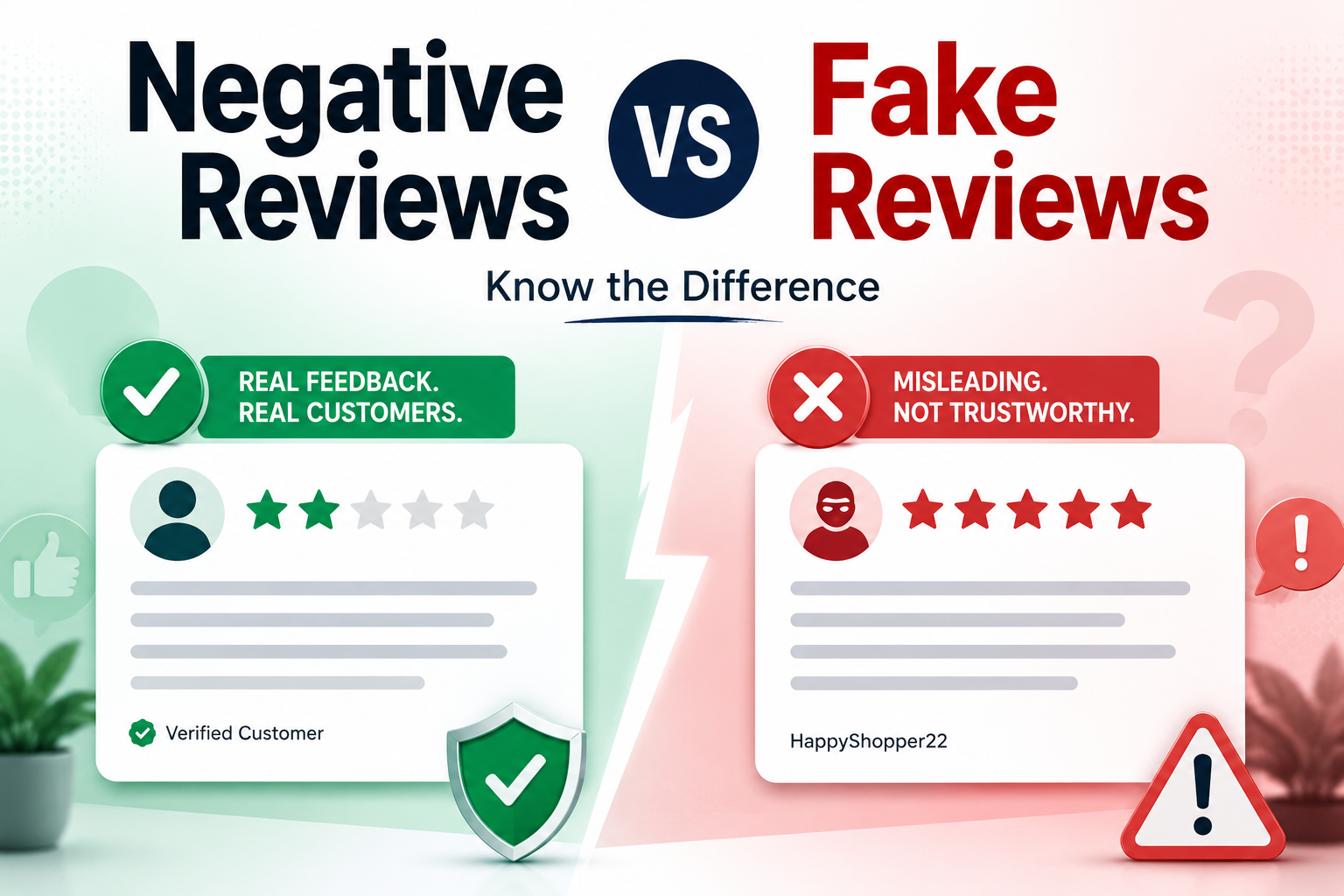
Online reviews play a major role in how people judge a business. Before buying a product, booking a service, visiting a restaurant, or applying for a job, many people read reviews first. Reviews help customers understand what to expect and help businesses build trust.
But not all reviews are the same. Some reviews are negative but genuine. Others are fake and created to damage or manipulate a business reputation. Understanding the difference between negative reviews and fake reviews is important because each one needs a different response.
A negative review may be uncomfortable, but it can give useful feedback. A fake review, on the other hand, can be unfair, misleading, and harmful.
What Is A Negative Review?
A negative review is a review written by a real customer who had a poor or disappointing experience with a business. The customer may complain about service, product quality, delivery delay, pricing, staff behavior, communication, or overall experience.
Even if the business disagrees with the review, it may still be genuine if the person actually used the product or service.
For example, a customer may write:
“The delivery was late, and customer support did not respond quickly.”
This is a negative review, but it may be based on a real experience. Review platforms usually allow genuine negative reviews because customers have the right to share honest opinions.
What Is A Fake Review?
A fake review is a review that is not based on a real customer experience. It may be posted by a competitor, bot, fake account, paid reviewer, former employee, or someone who never used the business.
Fake reviews can be positive or negative. Fake positive reviews are used to improve ratings unfairly. Fake negative reviews are used to damage a business reputation.
For example, if someone who never visited your business writes:
“This company is a scam. Never use them.”
and there is no record of that person as a customer, it may be a fake review.
Why The Difference Matters
The difference between negative and fake reviews matters because platforms treat them differently.
A genuine negative review usually cannot be removed just because it is critical. If the customer had a real experience and the review follows platform rules, it may stay online.
A fake review may be reported if it violates platform policies. If the platform confirms that the review is fake, spam, abusive, or misleading, it may be removed.
Businesses should not report every negative review as fake. Doing so can waste time and may reduce credibility. Instead, they should identify clear signs of fake activity before reporting.
Main Highlights
| Feature | Negative Review | Fake Review |
|---|---|---|
| Based on real experience | Yes | No |
| Can be removed easily | Usually no | Possible if policy-violating |
| Best response | Professional reply | Report with evidence |
| Purpose | Share dissatisfaction | Mislead or damage reputation |
| Value for business | Can provide feedback | Usually harmful |
| Example | Complaint about slow service | Review from non-customer |
Common Signs Of A Negative Review
A negative review usually has details about a real experience. It may mention a product, service, staff interaction, delivery issue, appointment, order, or visit.
Signs of a genuine negative review include:
- Specific details about the experience
- Mention of actual service or product
- Realistic complaint
- Clear timeline
- Customer emotion based on experience
- No spam links
- No repeated copied text
- Reviewer may have other normal reviews
Even if the review feels unfair, it may still be genuine.
Common Signs Of A Fake Review
Fake reviews often look suspicious. They may be vague, extreme, repetitive, or unrelated to your business.
Signs of a fake review include:
- No customer record
- Fake or suspicious profile
- Very generic wording
- Extreme accusations without details
- Same review posted on multiple businesses
- Mentions services you do not offer
- Includes spam links
- Posted by a competitor
- Sudden review attack from many accounts
- Reviewer refuses to provide details
- Review is unrelated to your business
These signs do not always prove a review is fake, but they can help you decide whether to investigate.
How To Handle Negative Reviews
Negative reviews should be handled with professionalism. A good response can reduce damage and show future customers that your business cares.
Here are steps to handle negative reviews:
1. Stay Calm
Do not respond emotionally. Even if the review feels unfair, your reply is public. Future customers will judge your response as much as the review.
2. Thank The Reviewer
Start by thanking the customer for their feedback. This shows maturity and professionalism.
3. Acknowledge The Concern
You do not need to admit fault, but you should show that you understand their concern.
4. Offer A Solution
Invite the customer to contact your support team or manager so the issue can be reviewed.
5. Keep It Short
Avoid long arguments. A short and polite reply is more effective.
Example response:
“Thank you for your feedback. We are sorry to hear that your experience did not meet expectations. Please contact our support team so we can review this and help resolve the issue.”
How To Handle Fake Reviews
Fake reviews need a different approach. Instead of only replying, you should collect evidence and report the review.
1. Check Your Records
Search your customer database, booking records, invoices, emails, and support tickets. See if the reviewer matches any real customer.
2. Take Screenshots
Save screenshots of the review, reviewer profile, date, rating, and any suspicious details.
3. Report The Review
Use the platform’s report or flag option. Choose the most accurate reason, such as fake engagement, spam, conflict of interest, harassment, or irrelevant content.
4. Provide Evidence
If the platform allows details, explain clearly why the review appears fake.
For example:
“We cannot find any customer record under this name. The review mentions a service we do not provide and appears to be unrelated to our business.”
5. Reply Carefully
While waiting for removal, you can post a calm public reply.
Example:
“Thank you for your feedback. We are unable to verify this experience in our records. Please contact us directly with more details so we can investigate.”
What Not To Do
Do not attack the reviewer. Do not reveal private customer information. Do not accuse someone publicly without proof. Do not ask friends or employees to post fake positive reviews in response.
Also, do not report every bad review as fake. Platforms may ignore reports that do not show real policy violations.
Why Negative Reviews Can Be Useful
Negative reviews are not always bad for a business. They can show areas that need improvement. If many customers complain about the same issue, it may point to a real problem.
Negative reviews can help improve:
- Customer service
- Product quality
- Delivery process
- Staff training
- Communication
- Website experience
- Pricing clarity
- Business operations
A business that responds well to criticism can build more trust than a business with only perfect reviews.
Why Fake Reviews Are Dangerous
Fake reviews are dangerous because they mislead customers. They can damage a business unfairly and reduce trust in review platforms.
Fake reviews can cause lower ratings, lost sales, reputation damage, stress for business owners, and unfair competition.
That is why businesses should monitor reviews regularly and report fake activity quickly.
How To Prevent Review Problems
You cannot prevent every negative or fake review, but you can reduce the risk.
Useful steps include:
- Provide good customer service
- Ask real customers for honest reviews
- Keep customer records organized
- Respond to reviews regularly
- Monitor review platforms weekly
- Train staff to handle complaints
- Resolve issues before they become public
- Report suspicious reviews early
- Avoid fake positive reviews
- Build a strong base of genuine feedback
A strong review profile makes both negative and fake reviews less damaging.
FAQs
1. Are all negative reviews fake?
No. Many negative reviews are genuine and based on real customer experiences. A review is fake only if it is not based on a real experience or violates platform rules.
2. Can a genuine negative review be removed?
Usually no. If the review follows platform rules and comes from a real customer, it may stay online even if it is critical.
3. How can I prove a review is fake?
You can check customer records, booking details, invoices, emails, and reviewer activity. Evidence helps when reporting the review.
4. Should I respond to fake reviews?
Yes, but keep the response polite and professional. Say that you cannot verify the experience and invite the reviewer to contact your business.
5. What is the best way to deal with negative reviews?
Respond calmly, acknowledge the concern, offer support, and use the feedback to improve your service.
Final Thoughts
Negative reviews and fake reviews are not the same. A negative review may come from a real customer who had a poor experience. A fake review comes from someone who did not have a genuine experience and may be trying to mislead others.
Businesses should respond to genuine negative reviews with professionalism and use them as feedback. Fake reviews should be documented, reported, and handled carefully.
By understanding the difference, businesses can protect their reputation, improve customer trust, and manage online reviews more effectively.

Leave a Reply