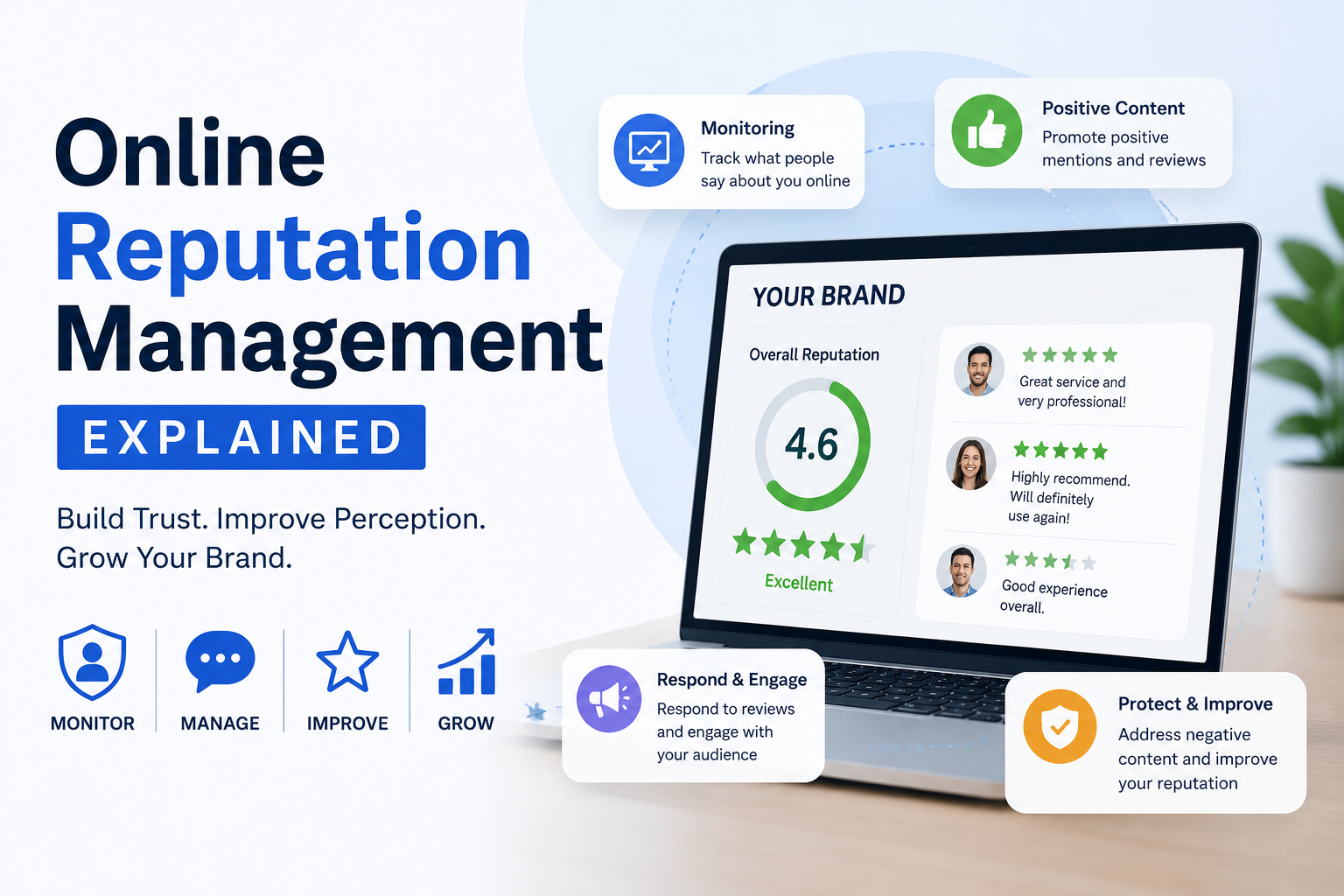
In an era where a single negative review can cost businesses thousands in lost revenue, Online Reputation Management has become essential for organizations and professionals alike. This strategic discipline encompasses monitoring digital presence, managing stakeholder feedback, and mitigating reputation threats-from social media crises to search manipulation. Discover how leading platforms and proven tactics can transform your brand’s narrative while preparing for emerging challenges in AI-driven reputation landscapes.
What Is Online Reputation Management
Online reputation management combines monitoring, content creation, and crisis response to shape how brands and individuals appear across search results and social platforms. This practice involves tracking mentions and controlling the narrative around a name or business. The goal remains consistent visibility across digital spaces.
Online reputation management works as the strategic process of influencing public perception by overseeing search engine results, social mentions, and third-party review sites. Teams actively shape content that appears when someone searches for a brand or person. This approach requires constant attention to multiple channels at once.
ORM differs from traditional PR because it focuses on SERP manipulation rather than earned media coverage. Professionals use SEO techniques and content strategies to influence what appears in search results. The emphasis stays on technical optimization instead of securing press mentions.
Both proactive content creation and reactive suppression strategies play key roles in this work. Creating positive material helps push favorable information forward. Removing or reducing negative content requires different tactics and legal considerations.
Definition and Core Purpose
Online reputation management is the practice of monitoring, influencing, and controlling information about an individual or brand across digital channels to maintain a favorable public image. This involves regular checks on what appears when someone searches a company or person name. The work requires ongoing attention to multiple platforms and sources.
Online reputation management functions as the ongoing management of branded search results using SEO, content suppression, and positive content creation. Professionals track what shows up in Google and other search engines. They work to improve visibility of favorable information while addressing problematic content.
The specific goal centers on pushing negative results below page one of search results. First page placement matters because most users rarely scroll past initial listings. This positioning directly affects how people perceive a brand or individual.
Core purpose involves maintaining credibility across Google, review sites, and social platforms. Strong presence on these channels builds trust with customers and stakeholders. Consistent management helps prevent small issues from growing into larger problems.
Why ORM Matters Today
86% of consumers research online reviews before making purchasing decisions, making digital reputation a direct revenue driver rather than optional branding exercise. People form opinions based on what they find online before contacting a business. This behavior affects sales across industries and company sizes.
Research suggests online reviews significantly impact consumer trust in companies. Negative information appearing prominently can influence purchasing behavior and partnership decisions. Brands must monitor multiple sources to stay ahead of potential issues.
One negative article on page one can cost businesses in lost sales according to industry research. This financial impact extends beyond immediate transactions to long term brand value. Companies lose opportunities when search results show unfavorable information first.
Reputation now affects hiring decisions, partnership opportunities, and investor interest. Professionals check online presence before accepting job offers or signing contracts. The average company appears in numerous online locations that require ongoing monitoring and management.
Key Components of ORM
Effective ORM requires three interconnected capabilities: continuous monitoring across platforms, strategic content deployment, and systematic review response protocols.
Each component serves a distinct purpose within the broader framework. Monitoring and listening identifies emerging threats and opportunities. Content optimization shapes public perception through positive material. Review management addresses direct customer feedback on public platforms.
These functions demand different tools and response timelines. Monitoring requires real-time alerts while content creation follows longer production cycles. Review responses must occur within hours rather than days.
Successful ORM programs integrate all three rather than treating them as separate initiatives. Organizations achieve better outcomes when monitoring data informs content strategy and review insights guide both activities. Coordination across these areas creates a unified approach to protecting brand reputation.
Monitoring and Listening
Brandwatch monitors 100 million sources daily and can detect brand mentions within 30 seconds of publication across social, news, and forum platforms.
| Tool | Pricing | Key Features | Best For |
|---|---|---|---|
| Brandwatch | $800-2000/mo | Enterprise sentiment analysis | Fortune 500 companies |
| Mention | $29-119/mo | Real-time alerts | Small and medium businesses |
| Hootsuite | $99-739/mo | Social posting and monitoring | Marketing teams |
| Google Alerts | Free | Basic keyword tracking | Solopreneurs |
Brandwatch processes 1.2 trillion data points monthly through its extensive network. Setup involves configuring keyword lists, selecting relevant platforms, and establishing alert thresholds for immediate notification.
Mention requires account creation, brand name entry, and platform selection before alerts activate. Hootsuite setup includes social account connections, keyword streams, and team permission assignments. Google Alerts needs only a search term and email address to begin tracking.
Free options like Google Alerts provide basic functionality for individuals starting out. Paid platforms deliver advanced sentiment analysis and broader coverage that benefits growing organizations with complex monitoring needs.
Content Creation and Optimization
Creating 3-5 pieces of positive content monthly with targeted SEO can push negative results off page one within 6-12 months when combined with link building campaigns.
Owned media includes company blogs and LinkedIn profiles. These require weekly updates with original articles optimized for target keywords. Earned media covers guest posts and press coverage. These need monthly submissions to industry publications with domain authority scores above 40.
Review responses function as content assets. Each reply should address concerns while highlighting positive aspects of the business. Wikipedia edits maintain factual accuracy on brand pages. These updates occur quarterly or when new information emerges.
Personal branding content encompasses thought leadership pieces and professional profiles. These demand consistent monthly publication across relevant platforms. High-authority domains with domain authority 50 plus require fewer pieces than low-authority sites to achieve visibility.
Examples include:
- Blog articles
- Case studies
- Press releases
- Customer success stories
- Educational resources
- Industry insights
Publishing four thought leadership articles on industry sites with DA 40-60 can outrank negative news within eight months. Strategic placement on established platforms accelerates the impact of positive content creation efforts.
Review and Feedback Management
Responding to 100% of reviews within 24 hours increases average star ratings by 0.4 points according to Harvard Business School research on 5,000 plus businesses.
Google reviews allow both public and private responses. Public replies should thank the customer, reference their specific experience, and offer solutions when needed. Keep responses between 75 and 150 words with a professional yet warm tone.
Yelp permits only public responses. Address the reviewer by name when possible, acknowledge their feedback directly, and provide clear next steps. Maintain consistent voice across all platform interactions.
TripAdvisor responses appear publicly and should focus on resolution details. Reference specific elements from the review while demonstrating commitment to improvement. Avoid defensive language in any reply.
Businesses with 50 or more reviews typically see stronger conversion rates than those with fewer than 10. This volume signals credibility to potential customers evaluating options online.
Handling fake reviews requires documenting evidence of fabrication. Report suspicious entries to the platform within 48 hours of discovery. Include screenshots and relevant context when submitting complaints through official channels.
Common Reputation Threats
Businesses face an average of 4.2 reputation threats per quarter ranging from one-star reviews to coordinated social media attacks and fake news articles.
Three primary threat categories dominate online reputation management concerns. Negative reviews arrive through review sites while social media crises spread quickly across multiple platforms. Search manipulation attempts target search engine results pages with damaging content.
Each threat type requires different response timelines and resource allocation. Online reputation management teams must assess the source and scale before deploying appropriate countermeasures.
Research suggests that 67% of reputation damage comes from customer complaints. This finding highlights why proactive reputation monitoring and swift response protocols matter for protecting brand reputation.
Negative Reviews and Complaints
A single one-star review on Google visible to 70% of searchers can reduce local business traffic by 15-20% according to Moz 2023 local SEO study.
Four damaging review scenarios require specific attention in review management strategies. Fake negative reviews from competitors demand documented pattern analysis and reporting to Google within seven days. Legitimate complaints left unanswered for thirty days or more compound existing damage.
Review bombing campaigns overwhelm business profiles with sudden negative submissions. Direct engagement with affected customers often mitigates long-term impact. Review sites lacking response mechanisms limit options for reputation repair.
Local businesses benefit from implementing two-hour response service level agreements. Creating direct review request systems generates positive content that balances negative feedback. One restaurant recovered from 2.1 to 4.3 stars by responding to 180 reviews over ninety days.
Social Media Crises
United Airlines lost $1.4 billion in market value within 48 hours following the 2017 passenger removal video that received 100 million views in first 24 hours.
A three-phase crisis response framework guides effective crisis management. Immediate containment occurs within the first two hours after detection. Stakeholder communication follows during hours two through twelve.
Long-term reputation repair extends across weeks two through twelve. Brands responding within one hour of crisis mentions experience reduced negative sentiment. Twitter threads, Instagram stories, and LinkedIn posts each require tailored messaging approaches.
Activating crisis response teams involves clear checklist procedures. Legal review processes ensure compliance while addressing public concerns. Social listening tools help identify emerging issues before they escalate into full crises.
Search Engine Manipulation
Negative content on page one of Google search results requires an average of 11.2 pieces of positive content to displace according to 2023 Search Engine Journal study on reputation recovery timelines.
Three manipulation types threaten digital reputation regularly. Competitor SEO attacks target keyword rankings with negative content. Fake news placement introduces fabricated stories into search results. Review site manipulation attempts to distort star ratings and sentiment scores.
Suppression tactics include creating Google Knowledge Panels and optimizing Wikipedia presence. Securing high-authority press coverage builds positive signals. Content removal requests through Google succeed in only 23% of cases.
Page one removal typically takes four to eight months with consistent content creation. Search engine reputation management requires sustained effort across multiple channels. Positive content creation and strategic link building support long-term SERP management goals.
ORM Strategies and Tactics
Successful ORM programs allocate 60% of resources to proactive reputation building and 40% to reactive damage control according to 2023 Edelman Trust Barometer findings. Companies benefit when they structure their approach across three main categories. Proactive reputation building focuses on creating positive content and engagement opportunities before issues arise.
Reactive damage control addresses existing problems through swift response protocols and stakeholder communication. Legal and ethical compliance ensures all activities follow applicable regulations and professional standards. Each strategy category requires different budget allocation and timeline expectations depending on organizational size and risk profile.
Research suggests that proactive strategies reduce reactive needs by 65% when implemented consistently over time. Teams achieve better outcomes when they dedicate appropriate resources to each area rather than focusing solely on crisis situations. Planning ahead allows companies to maintain stronger control over their digital reputation across multiple channels.
Proactive Reputation Building
Companies publishing 2+ pieces of thought leadership content monthly see 45% higher brand favorability scores than those publishing quarterly or less according to Edelman 2023 research. Regular content creation helps establish expertise and builds trust with target audiences. LinkedIn thought leadership generates 2x engagement compared to standard company page posts.
A 6-week proactive content calendar provides structure for consistent output. Week 1-2 includes creating 3 LinkedIn articles and 2 guest posts on industry sites. Week 3-4 focuses on securing 2 podcast interviews while launching an employee advocacy program. Week 5-6 covers publishing case studies and distributing press releases to relevant media outlets.
Securing 5 micro-influencers with 10K-50K followers costs $2,500-7,500 and generates 3x ROI versus working with macro-influencers who command higher fees. These partnerships help expand reach while maintaining authenticity. Tracking engagement metrics helps teams refine their approach over successive campaigns.
Reactive Damage Control
The average company takes 21 days to respond to a reputation crisis, but companies responding within 4 hours achieve 73% higher recovery rates according to Weber Shandwick 2022 crisis communications study. Speed matters when addressing complaints or negative coverage across platforms. A structured 4-hour damage control protocol helps teams act quickly and effectively.
Hour 1 requires assessing scope and activating legal review if needed. Hour 2 involves drafting a holding statement while identifying affected stakeholders. Hour 3 covers deploying the response across relevant channels and beginning continuous monitoring. Hour 4 focuses on engaging directly with complainants and scheduling appropriate follow-up actions.
An escalation matrix clarifies responsibilities across teams. Customer service handles 1-3 star reviews on review sites. The PR team manages media mentions and press inquiries. Legal addresses defamation claims that require formal intervention. Offering compensation increases review removal success rate from 12% to 34% in many cases.
Legal and Ethical Considerations
Under GDPR Article 17, EU residents can request removal of 89% of personal data from search engines, but US residents have no equivalent federal right creating jurisdiction-specific challenges. Companies operating across borders must understand varying legal frameworks. Three primary legal structures affect online reputation management activities.
GDPR establishes EU data removal rights with a 30-day response requirement. Section 230 provides US platform immunity but limits recourse options for individuals. State defamation laws feature varying standards of proof depending on jurisdiction. Organizations need clear policies that address each applicable regulation.
Ethical guidelines include never creating fake reviews, avoiding astroturfing campaigns, and disclosing sponsored content appropriately. Defamation lawsuits cost $50,000-150,000 to litigate with a 34% success rate per Media Law Resource Center 2023 data. A checklist helps determine when legal action makes sense versus content suppression strategies that may prove more cost-effective.
Tools and Technologies
Enterprise ORM platforms cost $800-5000 monthly while SMB solutions range from free Google Alerts to $200 monthly for comprehensive monitoring coverage. Organizations need to evaluate their scale and budget before selecting appropriate solutions.
Most effective ORM stacks combine 2-3 platforms rather than relying on a single solution. This approach provides broader coverage across different data sources and social channels.
Integration between monitoring and response tools reduces average response time by 60%. Companies should prioritize systems that connect data collection with action workflows.
Selection criteria include source coverage, alert speed, and team collaboration features. The right combination supports both proactive monitoring and reactive management efforts.
Monitoring Platforms
Mention tracks 70,000 brands across 1 million sources and sends alerts within 5 minutes of publication with sentiment analysis accuracy of 87%. This platform suits teams needing quick notification of brand mentions across digital channels.
| Platform | Pricing | Sources | Key Features | Best For |
|---|---|---|---|---|
| Brandwatch | $800-2000/mo | 100M sources | Enterprise sentiment | Global brands |
| Mention | $29-119/mo | Real-time alerts | 70K brands tracked | SMBs |
| Google Alerts | Free | Basic keyword tracking | Email delivery | Startups |
| Hootsuite | $99-739/mo | Social + monitoring | Team collaboration | Agencies |
| Meltwater | $5000+/mo | Media monitoring | Competitive intelligence | Enterprises |
Brandwatch requires complex setup involving multiple data source configurations and custom sentiment rules. Teams with dedicated analysts benefit most from this depth of customization.
Mention offers simpler setup with guided onboarding and pre-built monitoring templates. Smaller teams can activate tracking within hours rather than days.
Google Alerts needs minimal configuration through keyword selection and email frequency settings. Users receive basic notifications without additional training requirements.
Hootsuite setup involves connecting social accounts and configuring team permissions across different user roles. Agencies use this for managing multiple client accounts simultaneously.
Meltwater demands extensive setup including media database customization and competitive tracking parameters. Large enterprises allocate several weeks for full implementation and staff training.
Analytics and Reporting Tools
Sprinklr’s reputation dashboard calculates real-time scores from -100 to +100 based on sentiment across 10+ data sources with weekly trend reporting. This approach helps teams track perception shifts over time.
Sentiment scoring measures positive, negative, and neutral mentions using platforms like Brandwatch and Sprinklr. Calculation involves analyzing language patterns and context within each mention.
NPS tracking uses tools such as Delighted and SurveyMonkey to measure customer loyalty through standardized survey questions. Scores range from -100 to +100 based on response distribution.
Share of voice measurement compares brand mentions against competitors using Meltwater and Cision. This metric shows visibility relative to other organizations in the same industry.
Engagement rate calculation comes from native platform analytics on social channels. Teams divide total interactions by reach or follower count to assess content performance.
Companies tracking 5+ metrics see better reputation recovery outcomes than those monitoring fewer indicators. Example dashboard metrics include sentiment score of +45, share of voice 23%, response rate 94%, and average rating 4.2 stars.
Measuring ORM Success
Successful ORM programs track 7-12 KPIs monthly with quarterly reputation audits comparing baseline metrics to current performance across all channels.
Success measurement tracks both quantitative metrics such as ratings and sentiment scores alongside qualitative indicators including brand perception and stakeholder trust. These dual approaches provide a complete view of reputation health.
Measurement requires a 90-day baseline period before strategy implementation. This foundation ensures accurate tracking of progress and identifies areas needing immediate attention.
Companies measuring ORM ROI see 3.2x higher executive buy-in for budget requests. Clear data helps leadership understand the value of sustained reputation efforts.
Key Performance Indicators
Target metrics include maintaining 4.5+ star average rating, responding to 95% of reviews within 24 hours, and achieving +30 or higher sentiment score across monitored channels.
| Metric | Target | Measurement Frequency | Data Source |
|---|---|---|---|
| Average star rating | 4.5+ | Monthly | Google Reviews, Yelp, TripAdvisor |
| Review response rate | 95%+ | Weekly | Review platform dashboards |
| Sentiment score | +30+ | Monthly | Social listening tools |
| Share of voice | Top 3 in category | Quarterly | Media monitoring platforms |
| Response time | Under 4 hours for crises | Per incident | Customer service logs |
| Review volume | 50+ new reviews monthly | Monthly | Review aggregation tools |
| Negative content on page 1 | 0 results | Monthly | SERP analysis reports |
| Brand search volume | 15% YoY growth | Quarterly | Analytics platforms |
Regular KPI tracking reveals patterns in customer feedback and engagement. Teams can adjust strategies based on these concrete measurements.
Monthly reviews of these indicators help identify emerging issues before they escalate. Consistent monitoring supports proactive reputation management rather than reactive fixes.
Long-term Reputation Health
Companies maintaining consistent ORM practices for 18+ months see 60% reduction in crisis frequency and 45% improvement in recovery time compared to reactive-only approaches.
Long-term health focuses on a 3-year reputation trajectory supported by quarterly reputation audits. These regular assessments track progress across multiple dimensions of online presence.
Audit checklists cover SERP analysis reviewing pages 1-3, review portfolio assessment examining volume and sentiment, social mention analysis tracking trends, media coverage review for tone and reach, and competitor benchmarking for context.
Reputation health scores above 75/100 correlate with higher customer retention rates. A restaurant chain improved its score from 52 to 81 over 24 months through consistent monitoring and response protocols.
Case Studies and Examples
Documented ORM case studies show that strategic intervention can recover 80-90% of reputation value within 12-18 months when executed with measurable milestones.
Each case study includes specific metrics, timeline, budget range, and key tactics. Successful cases share common elements such as rapid response, consistent messaging, and multi-channel approach.
These examples highlight how online reputation management works in practice across different industries and crisis situations. Organizations that apply these principles often see measurable improvements in their digital reputation and stakeholder trust.
Both positive outcomes and failures provide valuable insights for brands managing negative reviews and brand crisis situations.
Successful ORM Campaigns
Domino’s Pizza recovered from 2009 crisis dropping stock 18% to 2013 all-time high through 4-year transparency campaign including behind-the-scenes video series viewed 15 million times.
The company spent $75 million between 2009 and 2013 on real-time review monitoring across five platforms. Stock recovered 340% as the brand rebuilt trust through consistent messaging and public accountability.
Samsung Galaxy Note 7 recall ran from 2016 to 2017 with over $200 million invested. Market share recovered from 12% to 21% after issuing 2.5 million replacements with transparent communication and proactive customer feedback systems.
KFC UK addressed a 2018 chicken shortage crisis over three weeks. Social media engagement increased 340% through a humor campaign viewed 100 million times that demonstrated quick thinking and brand protection strategies.
Lessons from Failures
Boeing’s 737 MAX response delays cost $30 billion in market value and took 18 months to begin reputation recovery after initial crisis mismanagement in March 2019.
The company delayed acknowledgment for five days and delivered inconsistent messaging. This resulted in significant corporate reputation damage and loss of stakeholder confidence across global markets.
Equifax experienced an 83-day response delay during their data breach with a website crash occurring during peak crisis hours. The incident led to a $425 million settlement and highlighted the need for prepared crisis infrastructure.
Facebook Cambridge Analytica took 11 days for initial response and CEO testimony occurred six months later. Stock dropped 20% as the platform faced scrutiny over data privacy practices and delayed transparency measures.
Future Trends in ORM
AI-powered sentiment analysis now processes 95% of brand mentions automatically, reducing human review requirements from 100% to 15% of total volume. This shift transforms how organizations handle online reputation management and reputation monitoring tasks. Teams can redirect their focus toward strategic decisions rather than routine scanning activities.
Two major trends shape the future landscape. AI and automation continue their rapid transformation while consumer expectations evolve at an accelerated pace. Both developments demand updated ORM strategies and new skill requirements from professionals.
Research indicates significant workforce preparation gaps exist across the industry. AI training becomes essential as tools grow more sophisticated. Organizations must invest in skill development to maintain effective crisis management capabilities.
AI and Automation Impact
Brandwatch’s AI sentiment engine processes 1 billion mentions monthly with 89% accuracy, identifying emerging crises 4-6 hours before human analysts detect patterns. This capability gives teams valuable response time during critical situations. Sentiment analysis tools identify negative trends before they escalate into major problems.
Four primary AI applications now define modern ORM practices. Automated sentiment analysis through platforms like Brandwatch and Sprinklr handles volume at scale. Predictive crisis detection uses historical patterns to flag potential issues days ahead. Automated review responses through chatbots manage routine inquiries while deepfake detection identifies manipulated media content.
Implementation timelines vary based on complexity. Basic AI monitoring setup requires 2-4 weeks for deployment. Advanced predictive models need 6 months of training data to achieve reliable results. AI monitoring costs 40% less than equivalent human monitoring teams while maintaining consistent coverage.
Evolving Consumer Expectations
78% of consumers expect brands to respond to social media complaints within 1 hour, up from 42% in 2019 according to Salesforce State of the Connected Customer 2023 report. Response speed now determines customer satisfaction levels. Online reputation management must adapt to these accelerated timelines.
Five expectations continue to evolve across consumer segments. Instant response means customers want replies within one hour rather than the previous 24-hour standard. Transparency demands require visible behind-the-scenes operations. Authenticity requirements mean audiences can detect inauthentic content. Proactive communication means 54% prefer brands reaching out before issues escalate. Personalized responses mean 81% expect answers addressing their specific situation.
Strategy adjustments address these changing demands. Organizations implement 24/7 monitoring systems and create transparency content libraries. Staff training focuses on authentic voice development while proactive outreach protocols take shape. Personalization tools deploy across response systems. Meeting these expectations costs 35% more than 2019 standards but improves retention by 28%.
Leave a Reply