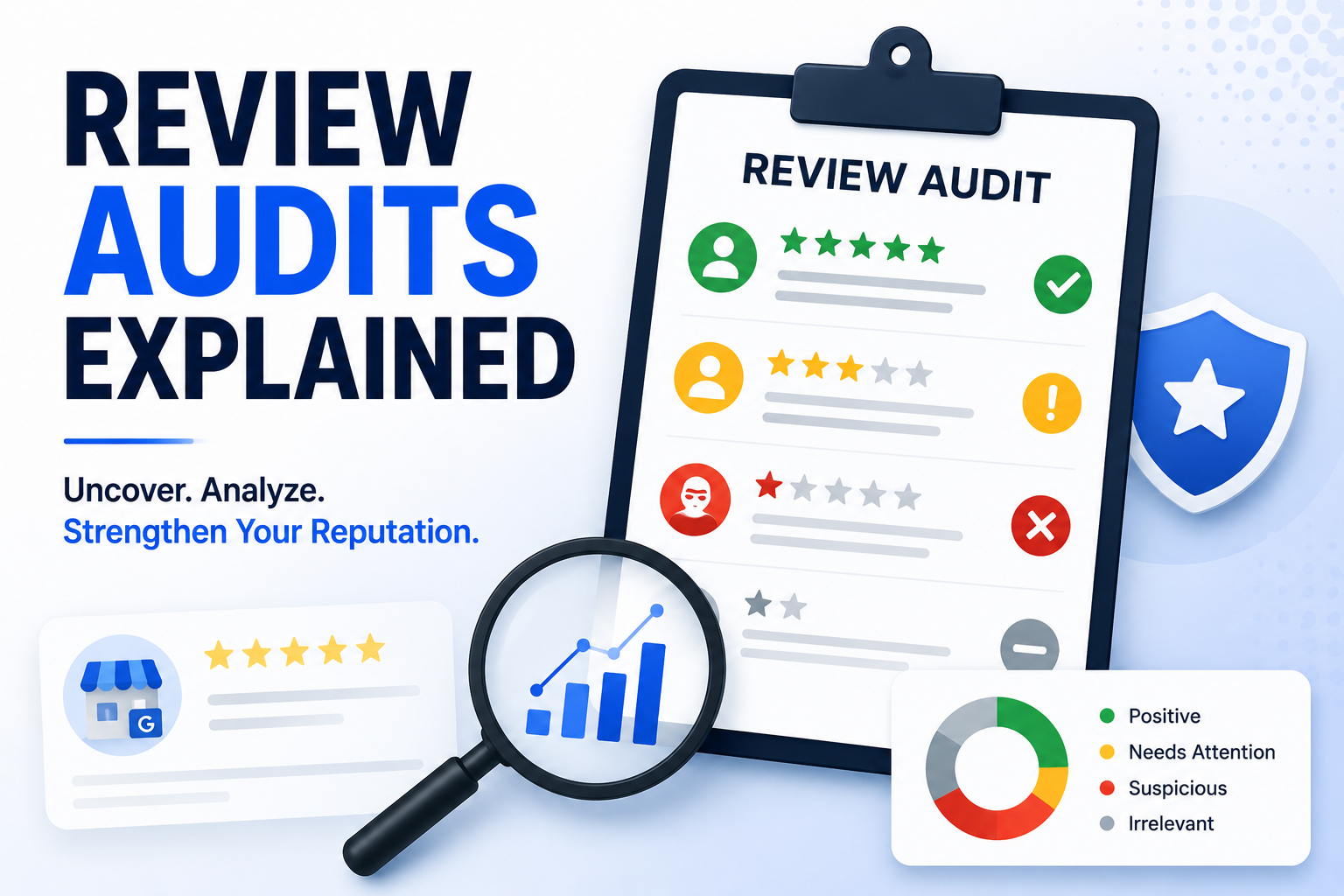
Online reviews can shape how people see a business. Before choosing a product, service, restaurant, clinic, hotel, or company, many customers read reviews to decide whether they can trust the brand. A strong review profile can increase confidence, while poor, fake, outdated, or unmanaged reviews can reduce trust.
This is where a review audit becomes useful.
A review audit is a detailed check of your online reviews across different platforms. It helps you understand what customers are saying, where your reputation stands, and what actions you should take to improve it.
What Is A Review Audit?
A review audit is the process of reviewing and analyzing customer feedback across platforms like Google, Trustpilot, Glassdoor, Yelp, Facebook, TripAdvisor, industry directories, app stores, and ecommerce websites.
The goal is to understand the quality, quantity, accuracy, and impact of your reviews.
A review audit helps answer questions like:
- How many reviews does the business have?
- What is the average rating?
- Are reviews recent or outdated?
- Are there fake or suspicious reviews?
- What complaints appear often?
- Are business responses professional?
- Which platforms need attention?
- Are customers mentioning the same problems?
- Are positive reviews being used properly?
- Are negative reviews affecting search results?
In simple words, a review audit shows the health of your online reputation.
Why Review Audits Matter
Reviews are not only customer opinions. They can affect trust, sales, local SEO, hiring, brand image, and customer decisions.
If a business does not monitor reviews, problems can grow quietly. A few unanswered negative reviews can create doubt. Fake reviews can damage ratings. Old reviews can make the business look inactive. Repeated complaints can show deeper service issues.
A review audit helps businesses find these issues early.
It also helps businesses understand what customers love. Positive reviews can reveal strengths such as friendly staff, fast delivery, good quality, helpful support, or fair pricing.
What A Review Audit Includes
A review audit can include many parts depending on the business type and platforms used.
Common areas include:
1. Review Quantity
This means checking how many reviews the business has on each platform. A business with very few reviews may look less trusted than competitors with hundreds of reviews.
Review quantity also helps show whether customers are actively sharing feedback.
2. Average Rating
The average rating gives a quick idea of customer satisfaction. For example, a business with a 4.7 rating may look more trustworthy than one with a 3.2 rating.
However, rating alone is not enough. A business should also check review details, freshness, and response quality.
3. Review Freshness
Fresh reviews matter because they show that the business is active. If the latest review is two years old, customers may wonder whether the business is still operating or whether service quality has changed.
A review audit checks whether new reviews are coming regularly.
4. Review Sentiment
Sentiment means the overall feeling of reviews. Are customers mostly happy, angry, disappointed, satisfied, or neutral?
A review audit looks at common words, emotions, and themes in customer feedback.
5. Common Complaints
Repeated complaints are important. If many customers mention slow delivery, rude staff, poor communication, or product issues, the business should take action.
A review audit helps identify patterns instead of focusing only on one review.
6. Positive Themes
Positive reviews show what the business is doing well. Customers may often praise fast service, clean facilities, friendly staff, expert advice, or affordable pricing.
These strengths can be used in marketing, website content, and service improvement.
7. Fake Or Suspicious Reviews
A review audit checks for reviews that may be fake, spammy, or policy-violating.
Signs may include:
- No real customer record
- Generic wording
- Repeated text
- Sudden review spikes
- Suspicious reviewer profiles
- Competitor-related reviews
- Reviews mentioning services not offered
- Spam links
- Extreme claims without details
Suspicious reviews should be documented and reported if they violate platform rules.
8. Business Responses
How a business responds to reviews matters. A professional response can improve trust, even when the review is negative.
A review audit checks whether the business responds regularly, politely, and helpfully.
Poor responses, emotional replies, or ignored complaints can harm reputation.
Important Factors
| Audit Area | Why It Matters |
|---|---|
| Review count | Shows customer activity |
| Average rating | Affects trust and clicks |
| Review freshness | Shows business is active |
| Common complaints | Reveals service issues |
| Positive themes | Shows business strengths |
| Fake reviews | Protects reputation |
| Response quality | Builds customer confidence |
How To Do A Review Audit
A review audit can be done step by step.
Step 1: List All Review Platforms
Start by listing every platform where your business has reviews. This may include Google, Facebook, Trustpilot, Glassdoor, Yelp, TripAdvisor, Justdial, app stores, ecommerce sites, or industry-specific directories.
Do not check only Google. Customers may be reading reviews on many platforms.
Step 2: Record Basic Metrics
For each platform, note:
- Total number of reviews
- Average rating
- Latest review date
- Number of negative reviews
- Number of positive reviews
- Response rate
- Common review topics
This gives a clear overview of your reputation.
Step 3: Read Reviews Carefully
Do not only look at star ratings. Read the actual comments. A 3-star review may contain useful suggestions. A 5-star review may mention your strongest selling point.
Look for patterns in customer language.
Step 4: Identify Repeated Issues
If the same complaint appears many times, it is not just a review problem. It may be a business problem.
For example, if many customers mention delayed response, the business may need better customer support systems.
Step 5: Find Reviews That May Violate Policies
Check for fake, abusive, spammy, or irrelevant reviews. Save screenshots and report them through the correct platform process.
Do not report every negative review. Only report reviews that clearly violate rules.
Step 6: Check Response Quality
Review your replies. Are they polite? Are they helpful? Do they sound human? Do they offer solutions?
Avoid copied responses for every review. Personalized replies feel more genuine.
Step 7: Compare With Competitors
Check competitor review profiles. Compare review count, rating, freshness, response quality, and common strengths.
This helps you understand where your business stands in the market.
Step 8: Create An Action Plan
After the audit, create a simple plan.
Your plan may include:
- Responding to unanswered reviews
- Reporting fake reviews
- Asking real customers for feedback
- Improving repeated service issues
- Updating business profiles
- Training staff
- Creating review response templates
- Monitoring reviews weekly
- Using positive reviews in marketing
Benefits Of Review Audits
Review audits help businesses make better decisions.
Benefits include:
- Better understanding of customer opinion
- Improved online reputation
- Stronger customer trust
- Better local SEO signals
- Faster detection of fake reviews
- Improved customer service
- Better review response strategy
- More useful marketing messages
- Competitive insights
- Higher conversion potential
A review audit gives businesses a clear picture of what is working and what needs improvement.
How Often Should You Do A Review Audit?
Small businesses can do a review audit every three months. Larger businesses or brands with many customer interactions may need monthly audits.
If your business gets reviews daily, weekly monitoring is useful.
Regular audits help you catch problems early and keep your reputation healthy.
Common Mistakes In Review Audits
Some businesses make mistakes when checking reviews.
Common mistakes include:
- Looking only at star ratings
- Ignoring old reviews
- Not checking all platforms
- Reporting every negative review
- Using copied replies
- Ignoring repeated complaints
- Not tracking review trends
- Forgetting competitor comparison
- Not creating an action plan
- Focusing only on removal
A good audit should lead to improvement, not just reporting.
FAQs
1. What is a review audit?
A review audit is a detailed check of online reviews to understand ratings, customer feedback, fake reviews, response quality, and reputation issues.
2. Why is a review audit important?
It helps businesses find reputation problems, improve customer service, report fake reviews, and build more trust with customers.
3. How often should a business do a review audit?
Small businesses can do it every three months. Larger or high-volume businesses may need monthly or weekly checks.
4. Can a review audit help remove fake reviews?
Yes. A review audit can identify suspicious or policy-violating reviews so the business can report them with evidence.
5. Does a review audit improve SEO?
Indirectly, yes. Better reviews, fresh feedback, strong responses, and improved customer trust can support local SEO and conversions.
Final Thoughts
Review audits are an important part of online reputation management. They help businesses understand what customers are saying, where problems exist, and how to improve their public image.
A good review audit looks at review count, rating, freshness, sentiment, fake reviews, common complaints, positive themes, and response quality. It also helps businesses create a clear action plan.
By auditing reviews regularly, businesses can protect their reputation, improve customer experience, and build stronger trust online.


Leave a Reply