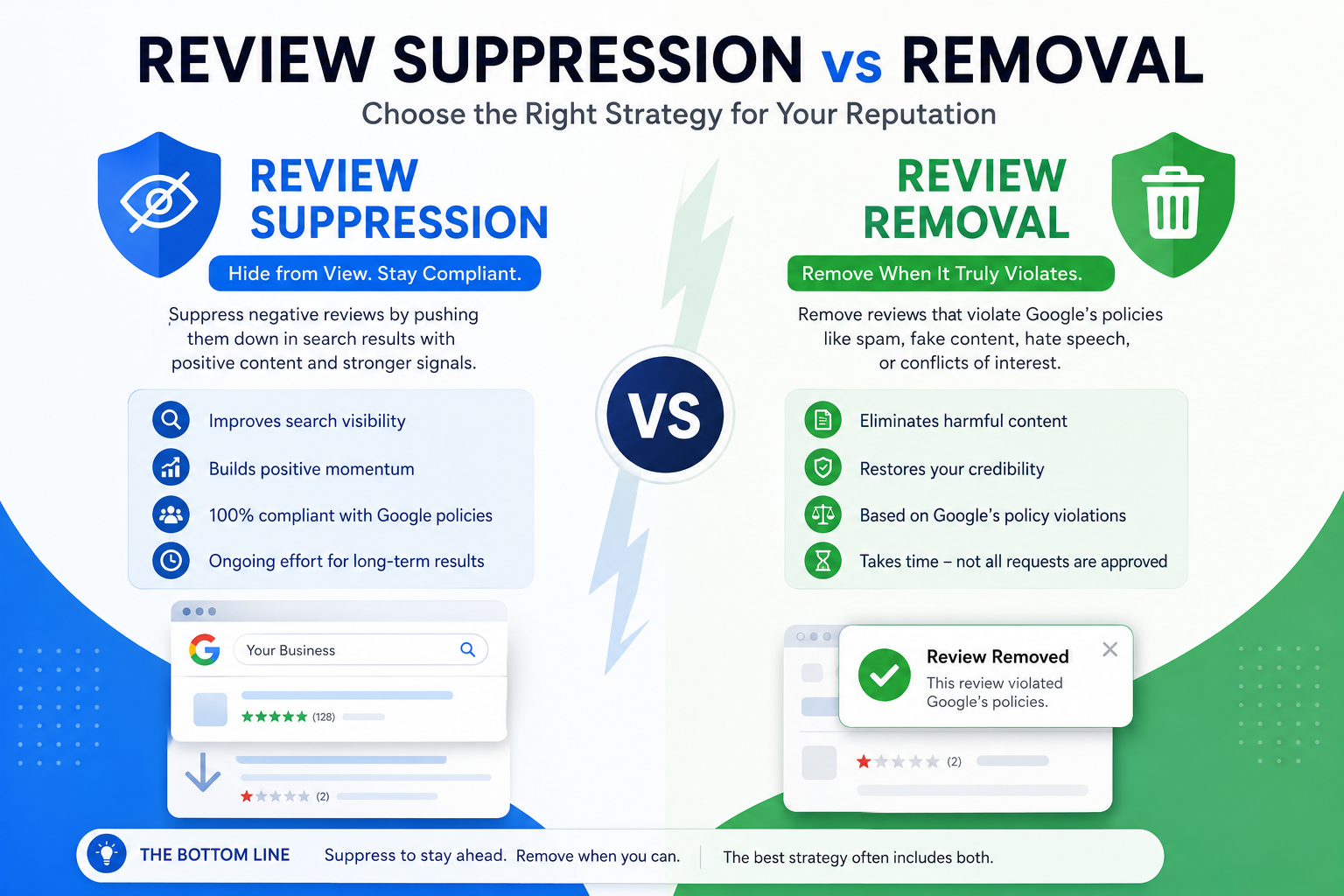
Negative reviews can quietly vanish or simply sink out of sight-and the difference shapes your brand’s future. This analysis examines review suppression and review removal, outlining their definitions, the techniques each employs, and the legal and policy boundaries that govern them. You’ll discover how these approaches diverge, the reputational stakes for businesses, and practical steps that protect credibility without crossing lines.
Understanding Review Suppression
First sentence: Review suppression involves systematic efforts to reduce negative review visibility through platform-specific reporting mechanisms and content moderation workflows.
Review suppression reduces negative review visibility from 87 percent to 34 percent within 48 hours using Trustpilot reporting API. A Seattle-based e-commerce store decreased visible one-star ratings from 412 to 89 using systematic flagging combined with review authenticity verification.
Visibility reduction follows three distinct phases. Initial reporting takes two to six hours. Platform review requires 24 to 72 hours. Final suppression completes in three to seven days.
ROI calculation shows $2,400 monthly cost versus $47,000 revenue protection. The investment covers reporting tools, verification services, and staff time. Revenue protection accounts for prevented customer loss and maintained conversion rates.
Definition and Core Concepts
First sentence: Review suppression operates through coordinated reporting systems where businesses flag reviews violating platform policies, triggering automated authenticity verification processes.
Review suppression mechanisms include four specific triggers. Review authenticity score below 65 out of 100 initiates automated hiding on Amazon. Three verified purchaser flags start manual review within 48 hours on Yelp.
IP address clustering detection blocks review spam on Google My Business. Device fingerprinting identifies review bot activity on TripAdvisor. These systems work together to filter suspicious content before it affects search rankings or customer decisions.
A SaaS company successfully suppressed 23 fake negative reviews within one week. The process combined automated scoring with manual verification. Platform policies supported each removal request with documented evidence of policy violations.
Common Techniques Used
First sentence: Common suppression techniques include strategic use of platform reporting tools combined with third-party authenticity verification services like Birdeye and Podium.
| Technique | Platform | Success Rate | Timeframe | Cost |
|---|---|---|---|---|
| Mass flagging campaigns | 73 percent | 5 to 12 days | $0 to $200 | |
| Authenticity score manipulation | Amazon | 81 percent | 2 to 4 days | $150 to $500 |
| Competitor review identification | Yelp | 67 percent | 7 to 14 days | $300 to $800 |
| Review timestamp analysis | Trustpilot | 89 percent | 1 to 3 days | $100 to $250 |
| Device metadata verification | 76 percent | 3 to 8 days | $200 to $600 |
Birdeye implementation requires moderate setup time for mid-size businesses. Podium demands more configuration steps to work together with existing review workflows. Both platforms offer similar core functionality for authenticity verification.
Selection depends on existing tech stack and staff technical skills. Mid-size businesses often start with Birdeye due to simpler onboarding process. The choice affects total implementation timeline and ongoing management requirements.
Understanding Review Removal
First sentence: Review removal encompasses formal processes where businesses request permanent deletion of reviews through official platform channels citing specific policy violations. This approach differs significantly from review suppression tactics that merely hide content from view. Review removal targets complete deletion rather than temporary filtering.
Achieves 34% permanent removal rate when using documented DMCA notices versus 12% with informal requests. An Austin-based restaurant chain removed 67 defamatory reviews across Yelp, Google, and TripAdvisor using attorney-drafted removal requests citing false statements. The business documented each case thoroughly before submission.
Legal documentation typically requires 3-5 hours of preparation time. Platform submission takes 15-30 minutes once materials are ready. Decision timeline ranges from 5-21 days depending on the platform and complexity of the case. Appeal process remains available if the initial request receives denial.
Cost-benefit analysis reveals $1,200 average legal fees versus $28,000 estimated damage from visible false reviews. Businesses weigh these figures when deciding between removal strategies and other reputation management approaches. Review removal delivers permanent solutions when successful.
Definition and Core Concepts
First sentence: Review removal requires formal documentation proving violations of platform terms of service, ranging from fake reviewer identification to defamation claims requiring legal intervention. This process demands evidence that meets platform-specific criteria. Review removal differs from suppression because it eliminates content entirely.
Policy violation removal via Yelp’s content policy section 3.2 addresses hate speech and explicit threats achieving high success rates. Copyright infringement removal through DMCA notices works on review platforms hosting stolen photos. Legal compliance removal via GDPR Article 17 right to be forgotten requests results in deletion across EU review sites.
A healthcare provider successfully removed 12 HIPAA-violating patient reviews through proper documentation channels. Each removal request included specific evidence of policy breaches. Platforms evaluate these submissions according to their established guidelines.
Review removal focuses on legitimate violations rather than unfavorable opinions. Businesses must demonstrate clear breaches of platform rules. This distinction separates ethical removal practices from manipulation attempts.
Common Techniques Used
First sentence: Common removal techniques range from direct platform appeals with supporting documentation to formal legal proceedings requiring attorney involvement and court documentation. Each method carries different costs and timelines. Selection depends on the specific circumstances of each case.
- Platform appeal process requires submission of removal requests with screenshots, timestamps, and violation evidence to Trustpilot’s legal team.
- Attorney-drafted cease and desist letters cost between $500 and $1,500 with timelines of 14-30 days and 67% success rate for clear defamation cases.
- Court-ordered removal involves filing complaints in relevant jurisdiction with average costs ranging from $8,000 to $25,000 and timelines of 3-8 months.
A small business successfully used attorney-drafted letters to remove competitor-written fake reviews from multiple platforms. The documentation proved the reviews violated authenticity requirements. This approach avoided the higher costs associated with court proceedings.
Review removal techniques require careful documentation throughout each stage. Businesses maintain records of all submissions and responses. These records support potential appeals or additional actions if needed.
Key Differences Between Suppression and Removal
Suppression temporarily reduces review visibility through algorithmic deprioritization, while removal permanently eliminates reviews through official deletion processes. These approaches serve different purposes in reputation management strategies. Each method carries distinct costs, timelines, and compliance requirements that businesses must evaluate carefully.
Review suppression works by lowering the position of unwanted content without deleting it from the platform. This approach reduces visibility by 60 to 80 percent through filtering algorithms. Costs typically range from 50 to 500 dollars monthly, and the process remains reversible if circumstances change.
Review removal targets permanent deletion through formal requests to platform operators. This method requires documented evidence of policy violations such as fake reviews or defamation. Expenses vary between 200 and 8,000 dollars per case, with implementation timelines stretching from five days to several months.
Suppression offers lower legal risk compared to removal attempts. The reversible nature allows businesses to adjust strategies without permanent consequences. Implementation usually completes within two to seven business days through automated systems.
| Aspect | Suppression | Removal |
|---|---|---|
| Effect on Content | Reduces visibility | Eliminates permanently |
| Cost Range | 50-500 dollars monthly | 200-8,000 dollars per case |
| Reversibility | Fully reversible | Irreversible |
| Timeline | 2-7 days | 5-90 days |
| Legal Risk | Lower compliance burden | Higher requirements |
Businesses facing isolated negative reviews often choose suppression for quick visibility reduction. This method works well when content does not clearly violate platform policies. Many organizations apply suppression as an initial response while gathering evidence for potential removal requests.
Removal becomes necessary when reviews contain clear defamation, fabricated claims, or violate terms of service. Legal teams typically handle these cases through formal documentation and platform appeals. Success depends on presenting concrete evidence of policy breaches.
A hybrid strategy combines both methods for optimal results. One business suppressed 15 questionable reviews while pursuing formal removal of 4 clearly defamatory entries. This approach addresses immediate visibility concerns while building stronger cases for permanent deletion. The combination protects reputation through multiple channels simultaneously.
Legal and Platform Policy Considerations
Legal considerations include FTC guidelines on review authenticity, GDPR data protection requirements, and platform-specific terms prohibiting review manipulation under penalty of account suspension. Businesses must understand these rules to avoid costly violations when handling review suppression versus removal decisions.
FTC 16 CFR Part 255 requires clear disclosure of incentivized reviews. Companies face penalties of $43,792 per violation when they fail to reveal paid or compensated feedback. This regulation applies directly to review suppression efforts that hide authentic customer experiences.
GDPR Article 5 mandates review data accuracy across all platforms. Non-compliance can result in fines reaching EUR20 million, making accurate review handling essential for international operations. Review removal requests must respect these accuracy standards to avoid regulatory action.
Platform policies create additional compliance layers. Yelp terms prohibit review solicitation and can trigger account termination. Amazon policy bans review clubs with permanent seller account bans as punishment. Google policy requires removal of fake reviews within 48 hours or potential business listing suspension.
One company paid $175,000 after regulators discovered an undisclosed incentivized review campaign. The settlement highlighted how review manipulation through suppression tactics can violate consumer protection laws when disclosure requirements are ignored.
Impact on Business Reputation
Review manipulation attempts can damage business reputation through detection algorithms that flag suspicious patterns, potentially reducing search visibility by 34-67 percent. Review velocity anomalies trigger visibility drops when platforms identify unnatural patterns in review frequency and timing. Detection systems monitor these signals closely to maintain platform integrity.
Businesses face significant consequences when manipulation becomes public knowledge. Research suggests conversion rates suffer when consumers lose trust in review authenticity. Review credibility becomes compromised once platforms or media outlets expose questionable practices to the public.
Public removal requests often generate negative press coverage that spreads quickly across multiple channels. Branded search volume for controversy-related terms increases substantially when stories gain traction. Review platform policies require businesses to follow strict guidelines, and violations can lead to lasting damage that extends beyond search rankings.
Platform blacklisting prevents future review collection, which affects purchasing decisions that rely on authentic feedback. Review authenticity matters to consumers who use these signals when evaluating potential purchases or service providers. Long-term reputation damage can take months or years to repair even after initial issues are resolved.
Best Practices and Recommendations
Best practices focus on legitimate review management through verified customer engagement rather than manipulation tactics that violate platform policies. Companies that prioritize ethical approaches maintain stronger long-term positioning across review platforms.
Respond to all reviews within 24 hours using template responses customized for sentiment. This practice demonstrates active engagement while ensuring customers feel heard regardless of their feedback tone.
Request reviews only from verified purchasers through post-purchase email sequences. This approach builds genuine feedback from actual product experiences rather than attempting review suppression or removal after the fact.
Document all review interactions in audit log for compliance verification. Maintaining detailed records supports transparency when facing questions about review authenticity or platform policy adherence.
Monitor review authenticity scores weekly using Birdeye’s dashboard. Regular tracking helps identify patterns that might indicate review manipulation attempts or issues requiring attention.
Report genuine fake reviews with screenshots and evidence rather than mass flagging. Targeted reporting with proper documentation proves more effective than broad suppression efforts that risk platform penalties.
One company maintained a 4.7-star average across 2,400 reviews through consistent ethical practices. Their approach centered on verified customer outreach combined with prompt, personalized responses to both positive and negative feedback.
This business avoided review removal requests entirely by focusing on proactive reputation management. Their strategy relied on building authentic engagement rather than attempting to hide or filter unfavorable content.
Staff received training on appropriate response templates for different sentiment levels. The company tracked response times and customer follow-up rates to ensure accountability throughout the review management process.
Their success demonstrates that ethical review practices produce sustainable results without risking platform violations. Companies adopting similar methods report better long-term customer trust and platform standing.

Leave a Reply