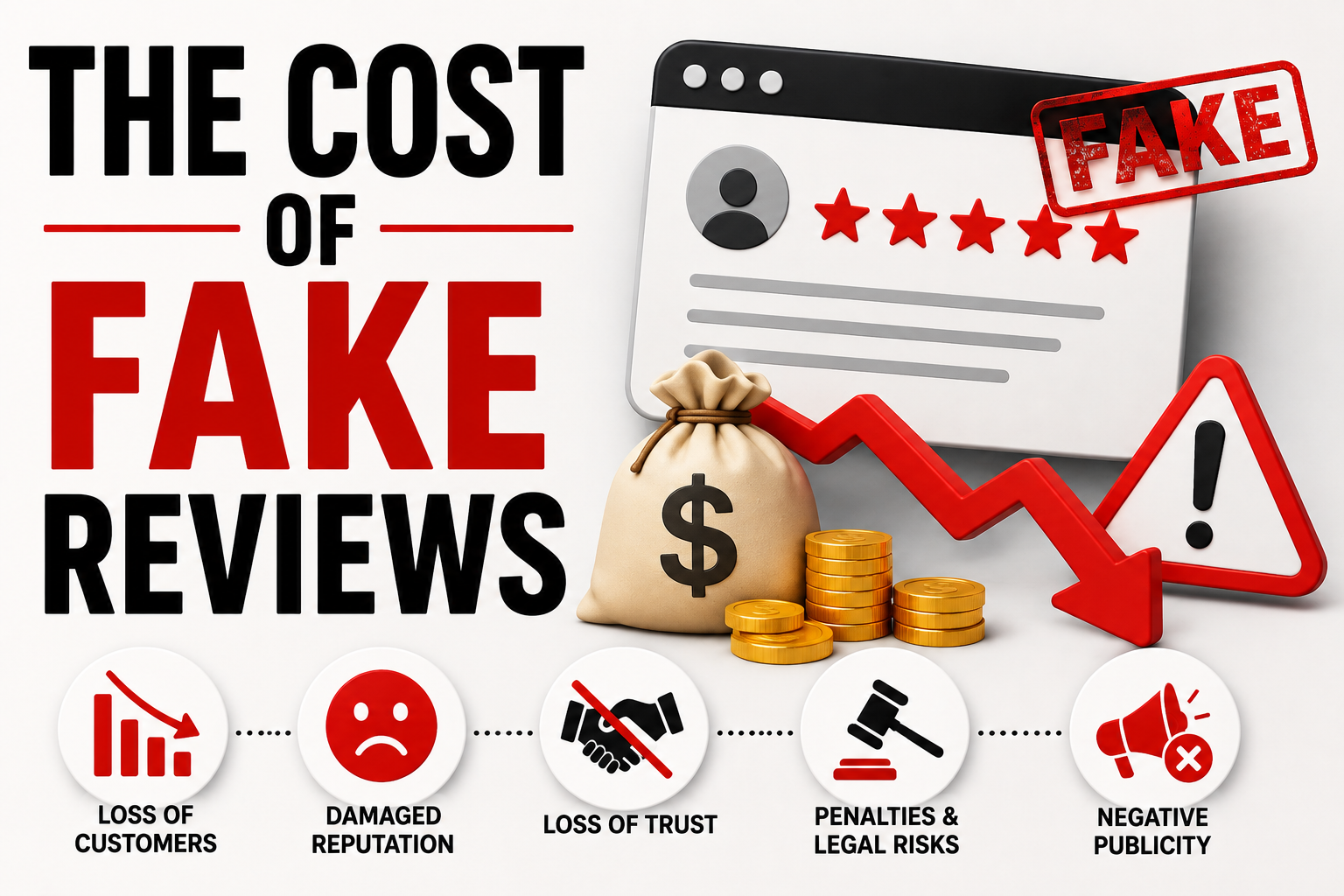
Online reviews can influence how people perceive a business before they ever make contact. A strong collection of genuine customer feedback can build confidence, while questionable or misleading reviews can create serious problems.
Some businesses may consider fake reviews because they want to improve their rating quickly, compete with larger companies, or overcome a period of negative feedback. The problem is that artificial reviews can create costs that are much greater than their initial benefit.
The cost of fake reviews is not limited to money. Businesses can also face damaged trust, platform action, reputation problems, customer complaints, and long term difficulty rebuilding credibility.
Understanding these risks can help businesses make better decisions about how they build their online reputation.
What Are Fake Reviews?
Fake reviews are reviews that do not represent a genuine customer experience.
They can include fabricated reviews written by someone who never purchased a product or used a service. They may also involve misleading reviews, manipulated feedback, or reviews created specifically to influence a business rating.
Fake reviews can be positive or negative.
A company might create positive reviews to make its business appear more popular.
Someone might also create negative reviews against a competitor to damage another company’s reputation.
Both practices can create serious trust issues.
Why Do Businesses Consider Fake Reviews?
Businesses may feel pressure to improve their online reputation quickly.
A new company may have very few reviews.
A business with several negative reviews may worry that potential customers will avoid it.
A competitor may have hundreds of positive reviews while the business has only a small number.
These situations can make artificial reviews appear attractive.
However, improving the appearance of a review profile without improving the actual customer experience does not solve the underlying problem.
Fake Reviews Can Damage Customer Trust
Trust is one of the most important parts of online reputation.
Customers expect reviews to represent real experiences.
If they discover that a business has fabricated feedback, their perception can change quickly.
Instead of thinking:
“This business has great customer experiences.”
they may think:
“This business tried to mislead me.”
That second impression can be difficult to reverse.
Customers May Notice Patterns
Fake reviews are not always obvious, but suspicious patterns can attract attention.
Potential customers may notice:
Very similar wording
Repeated phrases
Unusual review timing
Large numbers of reviews appearing suddenly
Generic comments with little detail
Accounts with unusual activity
Reviews that do not describe actual products or services
A business does not need every suspicious review to be identified for the strategy to become risky.
Even a small amount of questionable activity can cause customers to question the rest of the profile.
Fake Reviews Can Hurt Your Brand Reputation
A brand’s reputation is built over time.
Businesses spend years developing recognition, customer relationships, and credibility.
Fake reviews can undermine that work.
If customers, partners, employees, or industry professionals believe a company manipulates its reputation, they may become less willing to trust its claims.
The damage can extend beyond review platforms.
People may discuss questionable reviews on social media, forums, community groups, or other websites.
Platform Policies Can Create Additional Risk
Review platforms generally have rules designed to protect the authenticity of customer feedback.
Businesses that violate those rules may face consequences depending on the platform and circumstances.
Possible actions can include review removal, warnings, profile restrictions, reduced visibility, or other enforcement measures.
The exact policies and enforcement methods vary by platform.
This is why businesses should understand the rules of each platform before starting any review campaign.
Fake Reviews Can Create Financial Costs
The initial cost of obtaining fake reviews may appear small compared with traditional marketing.
However, the potential financial consequences can be much larger.
A reputation problem can lead to:
Lost customers
Lower conversion rates
Additional reputation management costs
Customer service expenses
Public relations work
Reduced partnerships
Lost business opportunities
Time spent correcting misleading information
The true cost is therefore difficult to calculate from the price of the reviews alone.
Negative Fake Reviews Can Hurt Competitors
Fake reviews are not limited to businesses promoting themselves.
Some unethical practices involve creating negative feedback about competitors.
This can be particularly damaging because the targeted business may have done nothing wrong.
Competitor attacks can also create legal, ethical, and platform related concerns depending on the circumstances.
Businesses should focus on improving their own customer experience instead of trying to damage another company’s reputation.
Fake Reviews Do Not Fix Poor Customer Experience
Imagine a company receiving complaints about slow customer support.
Adding positive reviews does not make the support process faster.
Customers who purchase from the company may still experience the same problem.
Eventually, their genuine feedback can conflict with the artificial reputation.
This creates a gap between what the business appears to promise and what customers actually experience.
That gap can become a serious reputation problem.
Genuine Reviews Are More Valuable
A genuine review can provide information that artificial feedback often cannot.
Real customers can describe:
What they purchased
How the service worked
How staff helped them
What they liked
What could be improved
How the product performed
How the company handled problems
These details can help potential customers make informed decisions.
They can also help the business understand what it is doing well.
Authentic Feedback Can Improve Your Business
Reviews should not be treated only as promotional material.
They are also a source of customer insight.
If customers repeatedly praise fast communication, the business can identify that as a strength.
If customers repeatedly complain about delivery delays, management can investigate the process.
This makes reviews useful beyond reputation.
They can contribute to product development, customer service, employee training, and operational improvements.
Fake Reviews Can Make Genuine Feedback Less Valuable
When a review profile contains questionable feedback, customers may become suspicious of everything they read.
This can reduce the value of genuine reviews.
Even real customers may find their feedback surrounded by comments that appear artificial.
A trustworthy review profile should therefore prioritize authenticity and consistency.
Review Quantity Is Not Everything
Businesses sometimes focus heavily on the number of reviews.
For example, a company may believe that having hundreds of reviews is automatically better than having dozens.
Quantity can matter, but context matters too.
A smaller collection of detailed and genuine reviews can provide meaningful information.
A large collection of vague or suspicious reviews may create doubts.
Businesses should focus on building a credible review history rather than simply chasing a number.
Recent Reviews Matter
Customers often want to know what the business is like now.
A company may have changed its products, employees, policies, or customer service processes.
Recent genuine reviews can help demonstrate the current experience.
Instead of trying to manufacture a sudden increase in feedback, businesses should create a consistent process for inviting real customers to share their experiences.
Building Reviews the Right Way
Businesses can encourage genuine reviews without manipulating customer opinions.
A practical process can include:
Providing a good customer experience
Asking customers for honest feedback
Making the review process convenient
Sending requests at an appropriate time
Allowing customers to use their own words
Responding professionally
Monitoring feedback
Fixing recurring problems
This approach takes more time than creating artificial reviews, but it creates a stronger foundation.
Ask for Honest Feedback
When asking customers for reviews, avoid telling them what rating to give.
Instead, ask for their honest opinion.
For example:
“We would appreciate hearing about your experience with our business. Your honest feedback helps us improve and helps future customers understand what to expect.”
This gives customers freedom to describe their actual experience.
Make It Easy for Customers to Respond
Satisfied customers may intend to leave reviews but forget.
A simple reminder can make the process easier.
Depending on the business, review invitations can be included after:
A completed purchase
A delivered order
A completed service
A successful support interaction
A finished project
The timing should allow the customer to have enough experience to provide meaningful feedback.
Respond to Genuine Reviews
Review management does not end after collecting feedback.
Respond to customers professionally.
Thank customers for positive experiences.
Acknowledge concerns in negative reviews.
Avoid arguing publicly.
If a problem is legitimate, investigate it.
Potential customers can learn a lot from the way a company responds to criticism.
Learn From Negative Reviews
A negative review does not automatically mean the entire reputation is failing.
It can identify an opportunity to improve.
Look for repeated complaints.
If several customers mention slow responses, investigate customer support.
If customers repeatedly mention confusing pricing, improve communication.
If customers complain about delivery delays, review logistics.
Fixing the underlying issue can produce better future reviews naturally.
The Long Term Cost of Losing Trust
Money can sometimes be recovered after a marketing mistake.
Trust can be harder to rebuild.
A customer who discovers that a business used fake reviews may not simply stop trusting its review profile.
They may question the company’s other claims.
That can affect the entire relationship.
This is why reputation management should focus on credibility rather than appearance alone.
A Better Reputation Strategy
A sustainable reputation strategy should combine customer experience with responsible review management.
Start by identifying what customers actually value.
Improve weak areas.
Ask genuine customers for honest feedback.
Respond consistently.
Monitor important platforms.
Track recurring themes.
Use feedback to make improvements.
Over time, these actions can produce a review profile that reflects the real strengths of the business.
What Businesses Should Consider Before Using Fake Reviews
Before taking any action that could involve artificial feedback, ask several questions.
Would customers consider this practice honest?
Does the platform permit it?
Could the activity be detected?
What would happen if customers discovered it?
Could it damage the company’s reputation?
Would the strategy still make sense if the reviews were publicly questioned?
These questions can reveal risks that are easy to overlook when focusing only on short term results.
Final Thoughts
The cost of fake reviews goes far beyond the price paid to create them.
Artificial feedback can create trust problems, platform risks, customer skepticism, financial losses, and long term reputation damage.
The strongest review profile is built around real customer experiences.
Businesses should focus on delivering good products and services, asking customers for honest feedback, responding professionally, and using reviews as a source of improvement.
A genuine review may take longer to earn than an artificial one, but it carries something fake feedback cannot provide: credibility.
In the long run, reputation is not about making a business appear perfect.
It is about giving customers enough real information to make confident decisions and demonstrating that the business is willing to listen, improve, and stand behind the experience it provides.
Frequently Asked Questions
What is the cost of fake reviews?
The cost can include the direct expense of obtaining them as well as potential losses from damaged trust, customer complaints, platform enforcement, reputation management, and lost business opportunities.
Are fake reviews illegal?
The legal position depends on the country, conduct, platform, and circumstances. Businesses should understand applicable consumer protection, advertising, and platform rules before using any review strategy.
Can fake reviews damage a business?
Yes. If customers or platforms identify artificial feedback, the business can face credibility problems and other consequences.
Can platforms remove fake reviews?
Many review platforms have systems and policies for identifying and removing content that violates their rules. The exact process varies between platforms.
Why are genuine reviews better than fake reviews?
Genuine reviews reflect real customer experiences. They can provide useful information to potential customers and valuable feedback to the business.
Can fake positive reviews improve a business rating?
Artificial reviews may appear to influence a rating, but the approach can create significant risks if the activity violates platform rules or customers discover the manipulation.
Can fake negative reviews hurt a competitor?
They can create reputational harm, but businesses should not use deceptive feedback to attack competitors. Such conduct can create serious ethical and potentially legal or platform related problems.
How can I get more genuine customer reviews?
Provide a good experience, ask customers for honest feedback at an appropriate time, make the process easy, and allow customers to describe their experiences in their own words.
Should I ask customers for five star reviews?
It is better to ask for honest feedback rather than directing customers toward a specific rating. Genuine feedback is more credible.
What should I do if my business has many negative reviews?
Look for recurring problems, respond professionally, resolve legitimate complaints, and improve the underlying customer experience. New genuine feedback can gradually provide a more current picture of the business.
Can negative reviews be useful?
Yes. Constructive negative feedback can identify problems in products, services, communication, delivery, or customer support.
How can I protect my business from fake negative reviews?
Monitor important review platforms, document genuine customer interactions when appropriate, and use the platform’s official reporting process when a review appears to violate its rules.
Are paid reviews always fake?
Not necessarily. The important question is whether the review represents a genuine customer experience and whether the arrangement complies with applicable laws and platform policies. Businesses should be transparent and avoid misleading customers.
How long does it take to build a trustworthy review profile?
There is no fixed timeline. A credible profile develops gradually through genuine customer experiences, consistent feedback requests, professional responses, and ongoing improvement.
What is the safest way to improve an online reputation?
Focus on customer experience first. Encourage genuine feedback, respond professionally to reviews, address recurring complaints, maintain accurate business information, and build trust consistently over time.

Leave a Reply