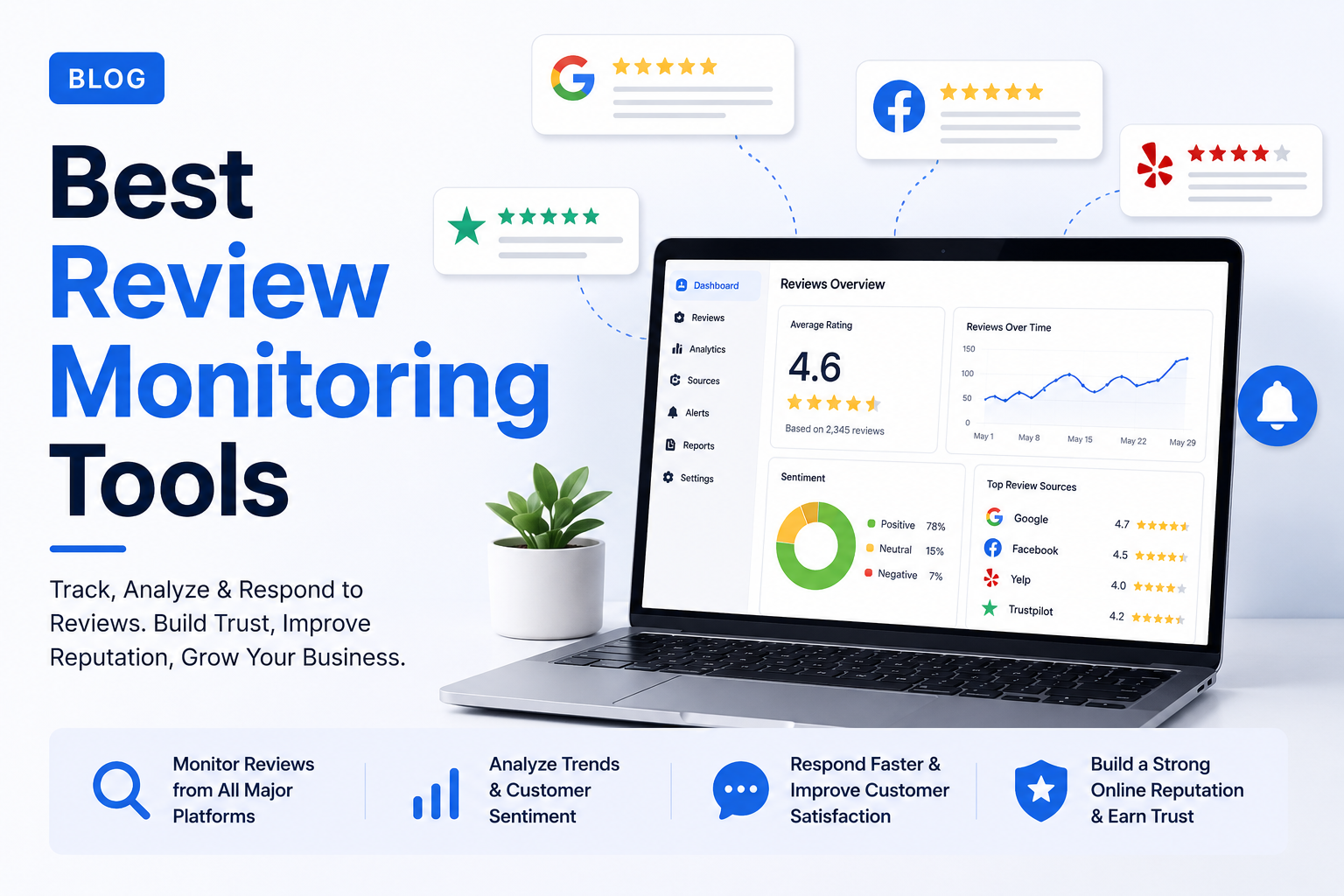
In an era where 93% of consumers cite online reviews as decisive purchase factors, unmonitored feedback poses substantial business risk. Effective review monitoring encompasses real-time alerts, sentiment analysis, and multi-platform integration-capabilities that distinguish leading solutions like ReviewTrackers, Birdeye, and buildyourreputation.com This analysis examines essential selection criteria, implementation strategies, and measurement frameworks that transform review management from reactive damage control into strategic brand intelligence.
Introduction to Review Monitoring
First sentence: Review monitoring tracks customer feedback across platforms like Google, Yelp, and TripAdvisor to protect brand reputation and identify improvement opportunities. Businesses monitoring reviews see 35% faster response times and 22% higher customer retention rates.
A 12-location restaurant chain using review monitoring reduced negative review impact by responding within 2 hours, improving their average star rating from 3.8 to 4.4 within 90 days. This outcome shows how timely action creates measurable results for multi-site operations.
Core functions include aggregation from 50+ review sites, sentiment scoring that breaks down positive, negative, and neutral percentages, and competitor benchmarking to compare performance across the market. A review monitoring tool pulls data into one central view for easier analysis.
Teams also benefit from real-time alerts that flag new posts and review response automation that speeds up replies without sacrificing quality. These features help maintain consistency across locations while reducing manual workload.
Storage of customer feedback must follow GDPR data privacy requirements. Businesses need clear consent processes and secure data handling to protect customer information during collection and review.
Key Features to Consider
Selecting review monitoring software requires evaluating alert speed, sentiment accuracy, and platform coverage against your specific business locations and review volume.
Businesses benefit from tools that match their operational scale. A local restaurant chain needs different capabilities than a national retail brand.
Focus on platforms that handle your primary review sources efficiently. Consider how each feature supports your daily workflow and response goals.
Teams should test integrations with existing systems before committing. The right combination of features improves response times and customer satisfaction over time.
Real-Time Alerts
Real-time alerts notify teams within 30-60 seconds of new review publication via email, SMS, or Slack integration.
A review monitoring tool should support several alert categories. Negative review alerts trigger at 1-3 star ratings with customizable response time SLA targets under 4 hours.
Review volume spikes detect when daily submissions exceed 50 percent above your average. Competitor review changes flag new 5-star or 1-star submissions on tracked locations.
Sentiment shifts use AI-powered classification to identify changes in tone. Set email digests for daily delivery at 9am and enable push notifications through the mobile app.
Webhook integration allows custom routing into your CRM system. These options keep teams informed without overwhelming inboxes.
Sentiment Analysis
Sentiment analysis uses natural language processing to classify review text as positive, negative, or neutral with 85-92 percent accuracy rates.
Star rating analysis maps the 1-5 scale directly to sentiment categories. Text mining extracts keywords such as slow service or excellent food from review content.
Aspect-based sentiment breaks down scores for food quality versus service versus ambiance. Topic modeling reveals patterns like wait time mentions across negative reviews.
A review summarization algorithm generates 2-3 sentence insights from batches of 50 or more reviews. Fake review identification relies on an authenticity score based on author profiling and verification status.
These methods help teams understand what drives customer opinions. Accurate scoring supports better decision making across locations.
Multi-Platform Support
Multi-platform support aggregates reviews from 15-50 sources including Google My Business, Yelp, TripAdvisor, Facebook, and industry-specific sites.
Google accounts for the majority of local searches with API availability and real-time data refresh. Authentication requires OAuth credentials for secure access.
Yelp provides over 180 million reviews with hourly refresh rates through its public API. TripAdvisor focuses on hotel and restaurant content with similar authentication methods.
Facebook connects to local business pages through its Graph API. Niche platforms like OpenTable, Zocdoc, and Healthgrades offer specialized connectors for their industries.
A review source management dashboard lets you toggle platforms on or off. The review source distribution pie chart displays percentage breakdown by platform for quick visibility.
Top Review Monitoring Tools
Three leading review monitoring platforms serve different business sizes with distinct pricing models and feature depth. These solutions help companies track customer feedback across multiple sources while streamlining response processes.
Review monitoring tools range from affordable options for small businesses to enterprise platforms with advanced capabilities. Each platform offers unique strengths in aggregation, automation, and reporting features.
Businesses select tools based on location count, budget constraints, and specific needs like compliance tracking or competitor analysis. The following sections examine three established platforms with proven track records.
Understanding these differences helps organizations choose solutions that align with their operational requirements and growth objectives.
ReviewTrackers
ReviewTrackers monitors 85+ review sites with starting price at $99/month for single-location businesses and $249/month for multi-location packages. This review monitoring tool aggregates feedback from dozens of platforms into one centralized dashboard.
The system pulls data daily from 85 platforms, ensuring businesses stay current with new reviews as they appear. Users receive notifications when feedback arrives across any connected source.
Review response automation features customizable reply templates that teams can adapt for different scenarios. Average response time reaches 4.2 hours with these tools in place.
Companies can track up to 10 competitors through the competitor review tracker function. This comparison reveals how peer businesses handle similar customer concerns and service challenges.
Analytics reports display star rating trends, review volume growth charts, and keyword cloud visualization. Teams export data in CSV or PDF formats for presentations and further analysis.
API integration connects the platform with custom dashboards and existing business systems. A Midwest hotel chain with 8 locations used these capabilities to increase response rates from 12 percent to 89 percent while improving their Google rating from 3.9 to 4.5 within six months.
Birdeye
Birdeye combines review monitoring with customer experience management at $299/month for up to 10 locations, scaling to enterprise pricing at $599/month for unlimited locations. This platform serves businesses seeking both reputation management software and broader feedback tools.
An automated review invitation system sends SMS and email requests after transactions complete. This approach generates an average response rate of 23 percent across client accounts.
Review response automation handles approximately 60 percent of incoming reviews through AI-suggested replies. Teams review and approve these suggestions before sending them to customers.
The platform includes an NPS tracking tool that connects with review sentiment scores. This integration provides a complete view of customer satisfaction across different interaction points.
A customer satisfaction metrics dashboard shows star rating trends and review volume by location. The system connects with over 50 practice management systems for seamless data flow.
Mobile app access allows managers to monitor reviews and respond from any location. Agencies benefit from white-label solutions that let them manage multiple client accounts under their own branding.
Reputation.com
Reputation.com offers enterprise-grade review monitoring starting at $500/month for single-location setups, with custom pricing for multi-location and agency clients managing 500+ locations. This platform targets organizations with complex compliance needs and large review volumes.
Review moderation tools use machine learning algorithms to identify potentially fake reviews. Company data indicates 98 percent detection accuracy for suspicious submissions.
The system benchmarks performance against over 10,000 similar businesses in comparable industries and geographic areas. This comparison helps teams understand where they stand relative to market standards.
Performance metrics track review engagement rate, average response time, and star rating improvement trends. Workflow automation includes escalation rules that route negative reviews to managers for review.
Compliance tracking covers GDPR requirements and data retention policies. The platform maintains detailed records for audit purposes and regulatory needs.
An agency dashboard and client portal support multi-client management for service providers. These features allow teams to oversee multiple accounts while maintaining appropriate access controls and reporting structures.
Implementation Best Practices
Successful review monitoring implementation requires defined response protocols, team role assignments, and weekly performance reviews rather than ad-hoc monitoring.
Assign review response ownership by location or category to ensure accountability. Set a response SLA of four hours for one and two star reviews. Apply a 24 hour window for three to five star reviews.
Create review reply templates for the ten most common scenarios. Include brand voice guidelines within each template. This approach speeds up review response automation without sacrificing consistency.
Set up review alert escalation rules that route negative reviews to managers automatically. Configure negative review alerts to trigger the correct workflow every time a low rating arrives.
Conduct weekly review audit trail reviews to analyze response quality and sentiment score changes. Track review performance metrics across all channels during these sessions.
Establish review SLA monitoring with monthly KPI tracking. Aim for a 95 percent response rate within the defined timeframes. Use your reputation management software to generate the necessary reports.
Configure review user roles with access control settings for team collaboration. Grant permissions to three to five staff members based on their responsibilities. Limit access to sensitive customer data through review permission settings while maintaining smooth collaboration.
ROI Measurement
First sentence: Review monitoring ROI calculates revenue impact from improved star ratings, reduced customer churn, and time savings from automated workflows. Businesses track these gains through several measurable channels. Review monitoring tools help connect rating changes directly to booking increases.
Revenue correlation works through steady improvements in customer perception. Small increases in average ratings often lead to higher conversion rates. Reputation management software captures these shifts and connects them to actual sales data over time.
Time savings come from replacing manual review checks with automated systems. Teams move from spending hours each week scanning multiple platforms to receiving targeted notifications. Real-time alerts flag only the reviews that need attention.
Customer retention improves when response rates increase. Faster replies help maintain relationships and encourage repeat business. Review response automation supports this process without requiring constant staff involvement.
Cost avoidance includes preventing reputation issues that lead to lost revenue. Negative reviews left unaddressed can affect future bookings. Negative review alerts help teams respond before problems grow larger.
Review performance comparison shows clear differences before and after implementation. Star rating analysis tracks movement from 3.8 to 4.3 over several months. Response time drops from 72 hours to 3 hours with automated workflows in place.
Review volume grows from 12 per month to 45 per month as engagement improves. Review volume trends reflect better visibility and customer interaction across platforms. These changes compound over time.
Monthly report template tracks five key performance indicators. Review KPI tracking includes average star rating, response rate percentage, sentiment score, competitor ranking, and revenue attribution from review-driven bookings. Teams review these numbers each month to adjust their approach.
Leave a Reply