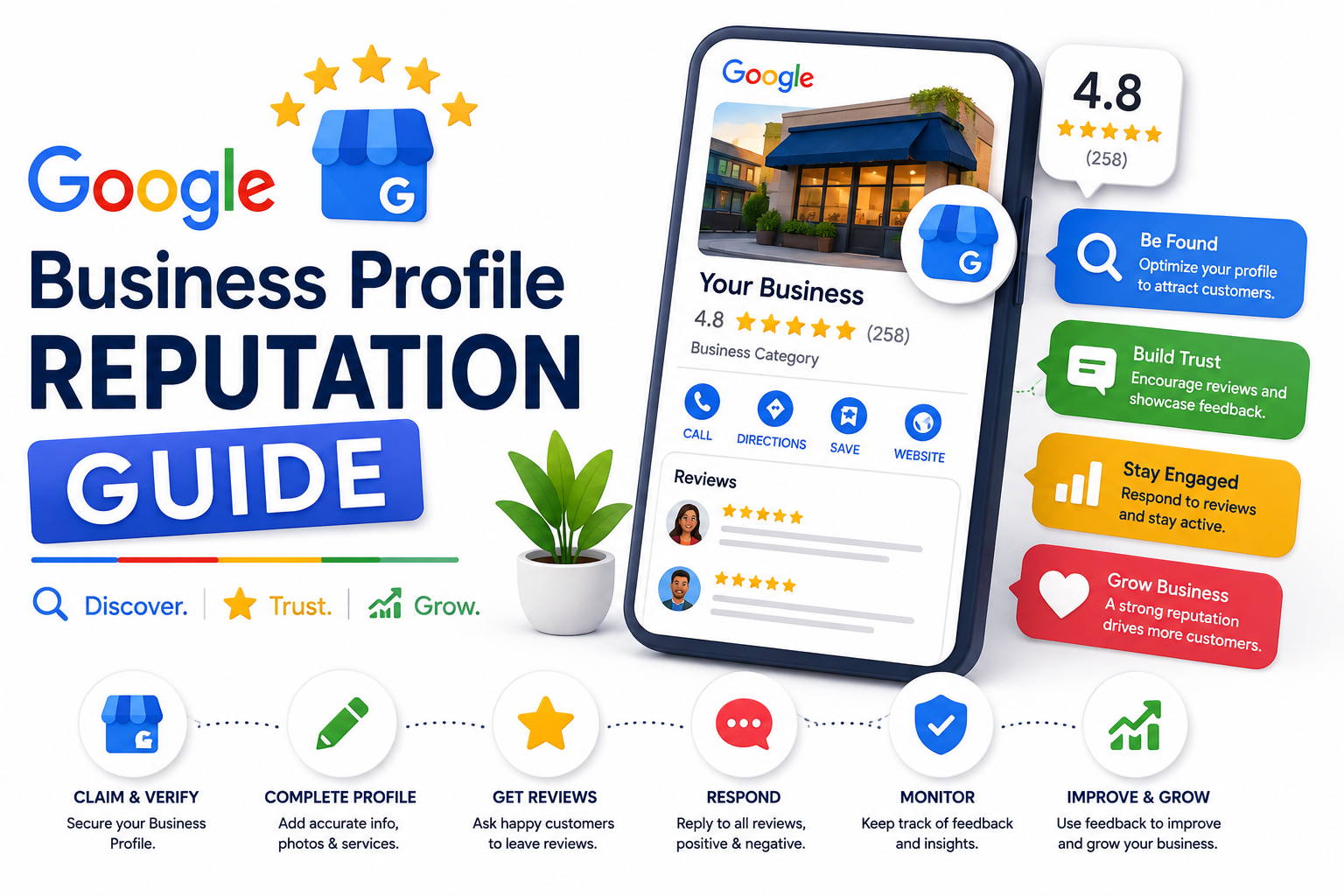
A Google Business Profile is often one of the first places potential customers see when they search for a local business.
Before visiting a store, booking a service, calling a company, or making a purchase, customers may check the business name, location, opening hours, photos, rating, and customer reviews.
This makes your Google Business Profile an important part of your online reputation.
A strong profile is not created simply by having a high rating. It should provide accurate business information, genuine customer feedback, helpful responses, and a clear picture of what customers can expect.
Managing your profile consistently can help your business build trust and create a better customer experience.
What Is Google Business Profile Reputation?
Google Business Profile reputation refers to how customers perceive your business based on the information and feedback they find on your Google Business Profile.
Several factors can influence this perception, including:
Overall review rating
Number of reviews
Recent customer feedback
Written reviews
Business responses
Photos
Business information
Customer questions and answers
Public interactions
A potential customer may consider several of these elements before deciding whether to contact your business.
Why Google Reviews Matter
Google reviews can influence how customers evaluate local businesses.
When people search for a company, they may see its rating and customer comments alongside other business information.
Reviews can help answer practical questions about the customer experience.
For example, customers may describe:
Service quality
Staff behavior
Product quality
Waiting times
Delivery
Communication
Professionalism
Value
These details can provide useful context that a business description alone cannot provide.
Keep Your Business Information Accurate
Reputation management begins with accurate information.
Review your Google Business Profile regularly to make sure important details are correct.
Check:
Business name
Address
Phone number
Website
Opening hours
Services
Business category
Business description
Incorrect information can create frustration.
For example, if your profile shows the wrong opening hours and a customer arrives when the business is closed, the resulting experience can lead to negative feedback.
Choose the Correct Business Category
Your primary business category helps describe what your company does.
Choose the category that most accurately represents your main business activity.
Avoid selecting categories simply because they appear popular.
Your profile should accurately represent your business.
Write a Clear Business Description
Your business description should help potential customers understand what you offer.
Explain:
What the business does
Who you serve
What products or services you provide
What makes the business useful
Keep the information clear and factual.
Avoid stuffing the description with repetitive keywords or exaggerated claims.
Keep Your Profile Active
A business profile should reflect an active company.
Depending on the features available to your business, keep relevant information updated.
This may include photos, services, products, posts, hours, and other profile details.
Regular maintenance can help ensure that customers receive current information.
Build Genuine Customer Reviews
A strong reputation starts with real customer experiences.
If customers are satisfied, make it easy for them to share honest feedback.
A simple request can be enough:
“We hope you enjoyed your experience. If you have a moment, we would appreciate your honest feedback on Google.”
The request should remain voluntary.
Ask at the Right Time
Timing matters.
Ask customers after they have had enough time to experience the product or service.
For example, a service business may ask after completing a project.
A retailer may ask after a customer receives and uses a product.
A restaurant may ask after the customer has finished their visit.
The right timing depends on the customer journey.
Do Not Ask for a Specific Rating
If you want genuine reviews, ask customers for honest feedback rather than specifically requesting five stars.
Customers should be free to describe their experiences in their own words.
This creates more authentic feedback.
Make the Review Process Simple
Customers may be willing to leave a review but forget or abandon the process if it is inconvenient.
Give customers clear instructions.
Where appropriate, provide a simple path to your Google review page.
Avoid unnecessary steps.
The easier the process, the more likely customers are to complete it.
Respond to Positive Google Reviews
A positive review deserves acknowledgment.
Thank the customer for taking the time to provide feedback.
If possible, mention something specific from the review.
For example:
“Thank you for your kind feedback. We are glad you enjoyed the service and appreciate you choosing our team.”
A personalized response can feel more genuine than a standard sentence copied across every review.
Respond to Negative Reviews Professionally
Negative reviews require careful handling.
Do not respond emotionally.
Read the review carefully.
Check what happened.
Acknowledge the customer’s concern.
Apologize when appropriate.
Provide a reasonable next step.
Avoid sharing private information.
A professional response can demonstrate that your business takes customer concerns seriously.
Do Not Argue With Customers
A public argument can make a negative situation worse.
Even if you believe the review is unfair, remain calm.
If clarification is necessary, provide factual information without attacking the customer.
For issues requiring personal details, invite the customer to continue the conversation through a private channel.
Potential customers may judge your business by how you handle difficult situations.
Recognize Genuine Problems
Not every negative review should be treated as an attack.
Sometimes customers identify legitimate problems.
If several reviews mention the same issue, investigate it.
For example, repeated complaints about:
Long waiting times
Slow responses
Delivery delays
Unclear pricing
Difficult booking
Poor communication
may indicate a process that needs improvement.
Report Reviews That Violate Google’s Policies
Businesses should not try to remove reviews simply because they are negative.
If a review appears to violate Google’s applicable content policies, use Google’s official reporting process.
Examples of potentially problematic content may include prohibited or inappropriate material.
The exact rules and enforcement process can change, so businesses should review Google’s current policies before taking action.
Do Not Buy Fake Google Reviews
Artificial reviews can create serious reputation risks.
A business may be tempted to increase its rating quickly, but fake feedback does not represent real customer experiences.
If suspicious activity is identified, the business may face consequences under platform policies.
More importantly, customers may lose trust if they discover that reviews were manipulated.
A sustainable reputation should be built around genuine feedback.
Avoid Review Gating
Review requests should not be designed to send only happy customers toward public reviews while directing unhappy customers away from public feedback.
The objective should be to invite genuine feedback fairly.
Businesses can use private feedback channels to understand customer problems, but they should not manipulate who is allowed or encouraged to leave public reviews.
Monitor New Reviews
Regular monitoring is an important part of Google Business Profile reputation management.
Check for:
New reviews
Unanswered reviews
Customer questions
Changes in rating
Recurring complaints
Positive feedback
Potential policy violations
The more frequently customers interact with your business, the more often you may need to monitor your profile.
Track Review Trends
Do not look only at the overall rating.
Track changes over time.
For example:
Are new reviews becoming more positive?
Are customers mentioning the same problem?
Are response times improving?
Are certain services receiving more complaints?
Are customers consistently praising specific employees?
Patterns can reveal more than a single rating.
Use Reviews to Improve Customer Experience
Your Google reviews can become a source of business intelligence.
Read them carefully.
If customers repeatedly praise fast support, protect that strength.
If customers complain about unclear instructions, improve the instructions.
If customers mention difficult booking, simplify the process.
The best reputation management strategies connect customer feedback with actual business improvements.
Keep Your Photos Current
Photos can influence the first impression customers receive from your profile.
Use accurate and relevant images that represent your business.
Depending on your business, useful photos may include:
Exterior
Interior
Products
Services
Team
Work environment
Completed projects
Avoid misleading images.
The goal is to help customers understand what they can realistically expect.
Manage Customer Questions Carefully
Customers may use the Google Business Profile interface to ask questions.
Monitor these interactions when available.
Provide accurate and helpful answers.
Avoid posting information that could confuse customers or conflict with your official business policies.
If a question reveals repeated confusion, consider whether your website or profile information needs improvement.
Keep Your Website Consistent
Your Google Business Profile and website should provide compatible information.
Check important details such as:
Business name
Services
Phone number
Location
Hours
Contact information
Major offers
Inconsistent information can create confusion.
Train Employees
Employees may interact with customers who later leave reviews.
Training can help employees understand how their communication affects the customer experience.
Focus on:
Professional communication
Problem solving
Clear explanations
Respectful interactions
Accurate information
Complaint handling
Employees should not pressure customers for positive reviews.
Create a Review Response Policy
If several employees manage the profile, establish basic guidelines.
Your policy can explain:
How quickly reviews should be checked
Who responds
What tone should be used
How negative reviews are escalated
What information must remain private
When a review should be reported
This creates consistency.
Protect Customer Privacy
Review responses are public.
Do not reveal sensitive customer information in your replies.
Avoid discussing private order details, payment information, personal contact details, or private conversations.
When a situation requires detailed discussion, move it to an appropriate private communication channel.
Do Not Overreact to One Negative Review
One negative review does not automatically mean your reputation is failing.
Look at the broader pattern.
If hundreds of customers are satisfied and one customer reports a problem, investigate the complaint without allowing it to dominate your entire strategy.
At the same time, do not automatically dismiss criticism.
Consider whether the review reveals a genuine issue.
Encourage Detailed Feedback
A detailed review can be more useful than a simple rating.
When asking for feedback, you can invite customers to describe their experience.
For example:
“What did you enjoy most about your experience?”
“What did you find helpful?”
“Is there anything we could improve?”
Do not tell customers what they should write.
Build Reviews Consistently
Do not wait until your rating drops before thinking about reviews.
Create a regular process for inviting genuine customer feedback.
This can produce a more current and representative profile over time.
Consistency is more sustainable than sudden review campaigns.
Use Customer Feedback Internally
Share useful review insights with your team.
Positive comments can provide recognition.
Negative comments can identify training opportunities.
Recurring suggestions can influence business improvements.
This turns your Google Business Profile into more than a marketing asset.
It becomes a feedback channel.
Measure Your Reputation
Businesses can monitor several indicators.
Consider tracking:
Overall rating
Number of new reviews
Review frequency
Recent review sentiment
Response rate
Common positive themes
Common complaints
Review trends
These measurements can help you understand whether your reputation strategy is improving.
Create a Simple Google Reputation Routine
A small business can start with a straightforward routine.
Check the profile regularly.
Respond to new reviews.
Invite genuine customers to share feedback.
Review recurring comments.
Update profile information.
Add relevant photos.
Address customer complaints.
Report policy violating content when appropriate.
Review reputation trends each month.
This does not require a complicated system.
Consistency is the most important part.
Final Thoughts
Your Google Business Profile is an important part of how customers discover and evaluate your business.
A strong reputation is not created simply by chasing a high rating.
It comes from accurate information, genuine customer experiences, thoughtful review requests, professional responses, and continuous improvement.
Businesses should treat Google reviews as both a reputation asset and a source of customer insight.
Positive feedback can show what customers value.
Negative feedback can reveal areas that need attention.
Both can help a business understand its audience better.
The most sustainable approach is to provide a good customer experience, invite honest feedback, respond respectfully, and use what customers say to improve the business.
Over time, these practices can help create a Google Business Profile that feels current, credible, and trustworthy to the people who discover it.
Frequently Asked Questions
What is Google Business Profile reputation management?
It is the process of monitoring and improving how customers perceive your business through your Google Business Profile, including reviews, business information, responses, photos, and customer interactions.
Why are Google reviews important?
Google reviews can provide potential customers with information about real experiences and can influence how they evaluate a business before making a decision.
How can I improve my Google Business Profile reputation?
Provide good customer experiences, invite honest feedback, respond professionally to reviews, keep profile information accurate, and address recurring customer concerns.
How can I get more Google reviews?
Ask genuine customers for honest feedback after an appropriate interaction and make the process easy for them.
Should I ask customers for five star Google reviews?
It is better to ask for honest feedback rather than requesting a specific rating. Customers should be free to share their actual experiences.
Can I buy Google reviews?
Artificial reviews can create significant trust and platform risks. A stronger long term approach is to build genuine reviews from real customer experiences.
Can I remove a negative Google review?
Businesses generally should not remove legitimate criticism themselves. If a review violates Google’s policies, you can use the available reporting process for consideration.
How should I respond to a negative Google review?
Remain professional, acknowledge the concern, check the facts, apologize when appropriate, and offer a reasonable way to resolve the issue.
Should I respond to positive Google reviews?
Yes. Thanking customers for their feedback can show that you appreciate their time and value their experience.
How often should I monitor my Google Business Profile?
The appropriate frequency depends on your business and review volume. Businesses with frequent customer interactions may benefit from checking more often.
Do Google reviews affect local search visibility?
Reviews are one of several factors associated with how businesses are presented and evaluated in local search. Businesses should focus on accurate information, genuine reviews, and a strong customer experience rather than trying to manipulate rankings.
What should I do if several customers complain about the same issue?
Investigate the underlying problem and make improvements where necessary. Repeated feedback can reveal weaknesses in your customer journey.
Should I respond to every review with the same message?
It is better to personalize responses when possible. Mentioning something specific from the customer’s review can make your response feel more genuine.
Can Google reviews help improve my business?
Yes. Reviews can reveal customer expectations, identify strengths, highlight problems, and provide ideas for improving products and services.
What is the biggest mistake in Google Business Profile reputation management?
Focusing only on the star rating. A strong reputation requires good customer experiences, genuine feedback, professional communication, accurate information, and continuous improvement.


Leave a Reply