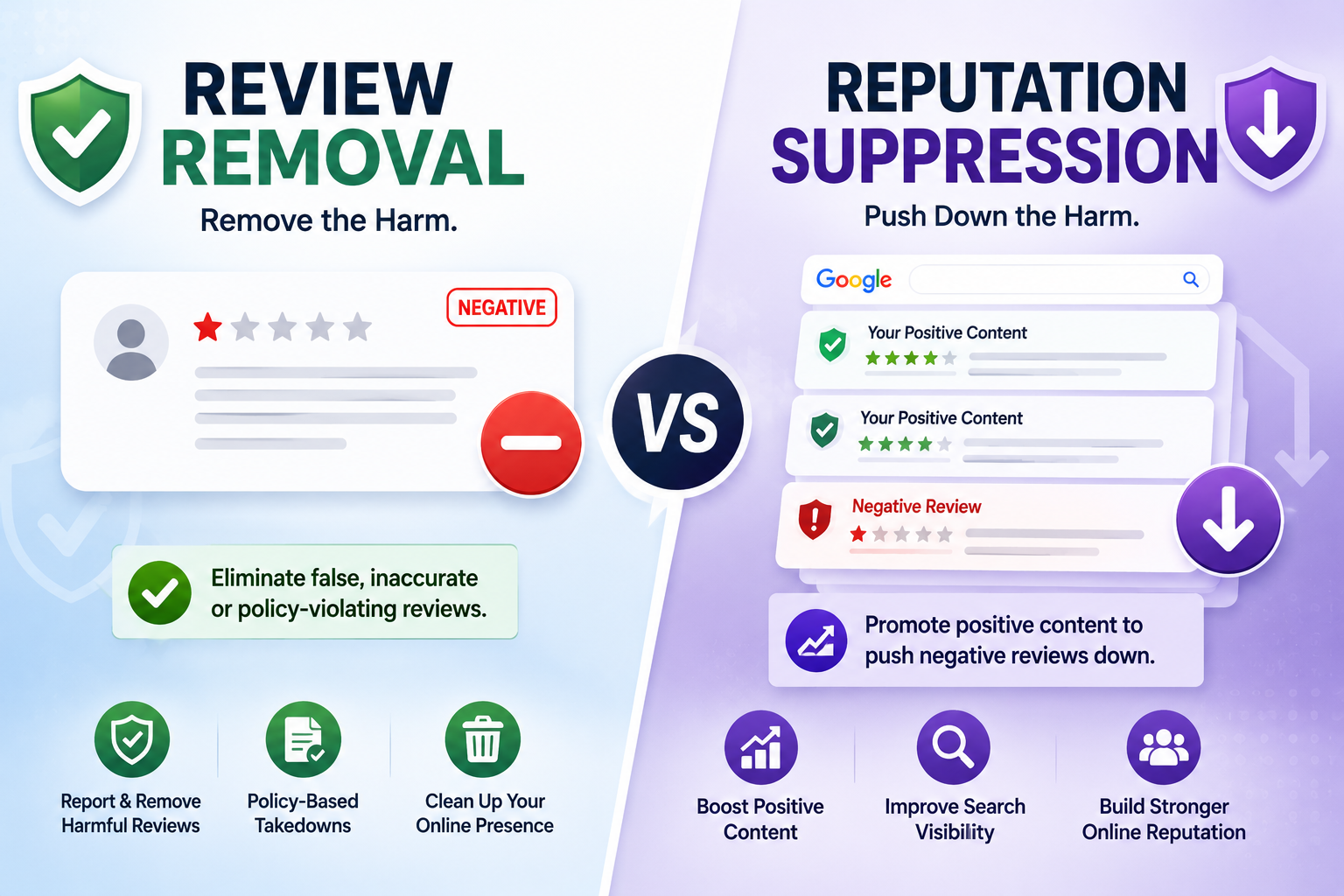
Online reviews can strongly influence how people see a business. A few positive reviews can build trust, while negative or fake reviews can reduce confidence. When harmful reviews appear online, many businesses want to remove them immediately. However, removal is not always possible. In many cases, reputation suppression becomes the better long-term solution.
Review removal and reputation suppression are two different strategies. Review removal focuses on taking down a specific review. Reputation suppression focuses on reducing the visibility and impact of negative content by building stronger positive content.
Understanding the difference helps businesses choose the right approach.
What Is Review Removal?
Review removal means asking a platform to delete or hide a review from public view. This usually happens when a review violates the platform’s rules.
For example, a review may be removed if it includes fake claims, spam, hate speech, threats, personal information, conflicts of interest, or irrelevant content.
Platforms like Google, Trustpilot, Glassdoor, Yelp, Facebook, and TripAdvisor usually do not remove reviews just because they are negative. The review must clearly break a policy.
This means review removal is useful when the review is fake, abusive, private, or policy-violating.
What Is Reputation Suppression?
Reputation suppression means reducing the visibility of negative content by promoting positive or neutral content. Instead of removing the negative review, the goal is to push it lower in search results or make it less noticeable.
For example, if a negative review page or complaint article appears on the first page of Google, a business may create and optimize positive content to outrank it. This can include blog posts, press releases, social profiles, videos, business listings, and customer success stories.
Suppression does not delete the negative content. It makes positive content more visible so people see a balanced and trustworthy image of the brand.
Why Businesses Need Both Strategies
Some reviews can be removed. Others cannot. A genuine negative review may stay online even if it hurts the business. A fake or abusive review may be removed if reported correctly.
That is why businesses often need both strategies. Review removal is useful for clear violations. Reputation suppression is useful when removal is not possible or when negative content ranks strongly.
A complete reputation strategy usually includes removal, suppression, review management, customer service improvement, and positive content building.
Simple Comparison
| Factor | Review Removal | Reputation Suppression |
|---|---|---|
| Main goal | Delete or hide a review | Reduce negative visibility |
| Best for | Fake or policy-violating reviews | Negative but hard-to-remove content |
| Speed | Can be faster if approved | Usually takes longer |
| Control | Depends on platform decision | More control through content strategy |
| Result | Review may disappear | Negative result may move lower |
| Long-term value | Limited to one review | Builds stronger online presence |
When Review Removal Is The Right Choice
Review removal is the right choice when the review clearly violates platform policies.
This may include:
- Fake reviews from non-customers
- Reviews from competitors
- Spam or promotional reviews
- Reviews with personal information
- Threats or harassment
- Hate speech or abusive language
- Reviews about the wrong business
- Reviews with confidential information
- Duplicate or copied reviews
In these cases, businesses should collect evidence and report the review through the platform’s official process.
When Reputation Suppression Is The Right Choice
Reputation suppression is useful when the review or negative content cannot be removed.
This may include:
- Genuine negative customer reviews
- Old but allowed complaints
- News articles that remain published
- Review pages that rank high
- Forum discussions
- Blog posts with criticism
- Search results that are negative but legal
- Content that does not violate platform rules
In these cases, the goal is to build stronger positive assets that can rank higher or reduce the impact of the negative result.
How Review Removal Works
The review removal process usually starts by identifying the violation. Businesses should not report a review only because it is negative. They should check the platform’s policy first.
The general process includes:
- Read the review carefully
- Identify the policy violation
- Take screenshots
- Collect evidence
- Report the review
- Choose the correct violation reason
- Submit a factual explanation
- Wait for platform review
- Appeal if possible
If the platform agrees, the review may be removed. If not, the review may stay online.
How Reputation Suppression Works
Reputation suppression works by creating and optimizing positive or neutral content that can rank higher than negative results.
This may include:
- Optimizing the official website
- Publishing helpful blog articles
- Creating social media profiles
- Updating business listings
- Posting press releases
- Creating YouTube videos
- Building positive review profiles
- Publishing case studies
- Earning media mentions
- Improving branded search results
The aim is to fill search results with trustworthy and useful content.
Benefits Of Review Removal
Review removal can be powerful when the review is clearly fake or harmful. If successful, the damaging review disappears from public view.
Benefits include:
- Removes unfair content
- Protects star rating
- Reduces customer doubt
- Helps restore trust
- Solves specific review issues
- Works well for policy violations
However, removal depends on the platform. Businesses cannot force platforms to delete genuine reviews.
Benefits Of Reputation Suppression
Reputation suppression helps build long-term brand strength. Even if one negative result remains, positive content can reduce its visibility and impact.
Benefits include:
- Improves overall search presence
- Builds brand authority
- Creates more positive first-page results
- Reduces impact of negative content
- Supports SEO
- Helps long-term reputation management
- Gives businesses more control
Suppression takes time, but it can create lasting benefits.
Limitations Of Review Removal
Review removal has limits. Platforms may reject removal requests if the review does not clearly violate policy. A negative opinion from a real customer may remain online.
Other limitations include:
- No guarantee of approval
- Review may return if reposted
- Platform rules vary
- Evidence may be required
- Some decisions cannot be appealed
- Removal may take time
This is why businesses should not rely only on removal.
Limitations Of Reputation Suppression
Reputation suppression also has limits. It does not delete negative content. It may take weeks or months to see results, especially if the negative result is from a strong website.
Other limitations include:
- Takes time and consistency
- Requires content creation
- Needs SEO strategy
- Cannot guarantee full removal
- Strong negative pages may be hard to outrank
- Requires ongoing monitoring
Suppression works best as a long-term strategy.
Which Strategy Is Better?
Neither strategy is always better. The right choice depends on the situation.
Use review removal when the review clearly breaks platform rules.
Use reputation suppression when the content is allowed, genuine, or difficult to remove.
For the best results, businesses should often use both. Report policy-violating reviews while also building positive content and encouraging genuine customer feedback.
How To Decide What To Do
Ask these questions:
- Is the review from a real customer?
- Does it include private information?
- Does it contain threats or hate speech?
- Is it spam or promotional?
- Is it about the wrong business?
- Does it violate platform policy?
- Can the platform remove it?
- Is the content ranking on Google?
- Can positive content outrank it?
If the review violates policy, try removal. If it does not, focus on response and suppression.
Best Practices For Businesses
To protect reputation, businesses should follow a balanced approach.
Useful practices include:
- Monitor reviews regularly
- Report only clear violations
- Respond professionally to negative reviews
- Encourage genuine customer reviews
- Avoid fake positive reviews
- Build strong website content
- Keep social profiles active
- Publish positive brand updates
- Improve customer service
- Track branded search results
A strong reputation strategy is not only about removing bad content. It is also about building trust.
FAQs
1. What is the main difference between review removal and reputation suppression?
Review removal tries to delete or hide a specific review. Reputation suppression tries to push negative content lower by ranking positive content higher.
2. Can all negative reviews be removed?
No. Genuine negative reviews usually cannot be removed unless they violate platform policies.
3. Is reputation suppression permanent?
Not always. Suppression needs ongoing content updates, SEO work, and reputation monitoring to maintain results.
4. Which is faster: removal or suppression?
Review removal can be faster if the platform approves it. Suppression usually takes longer because it depends on SEO and content ranking.
5. Should businesses use both strategies?
Yes. Businesses should report policy-violating reviews and also build positive content to protect long-term reputation.
Final Thoughts
Review removal and reputation suppression are both useful, but they solve different problems. Review removal works best for fake, abusive, spammy, or policy-violating reviews. Reputation suppression works best when negative content cannot be removed but can be pushed lower or balanced with positive content.
A smart reputation strategy uses both methods. Remove what clearly violates rules, respond professionally to genuine feedback, and build strong positive content that reflects the real value of your business.

Leave a Reply