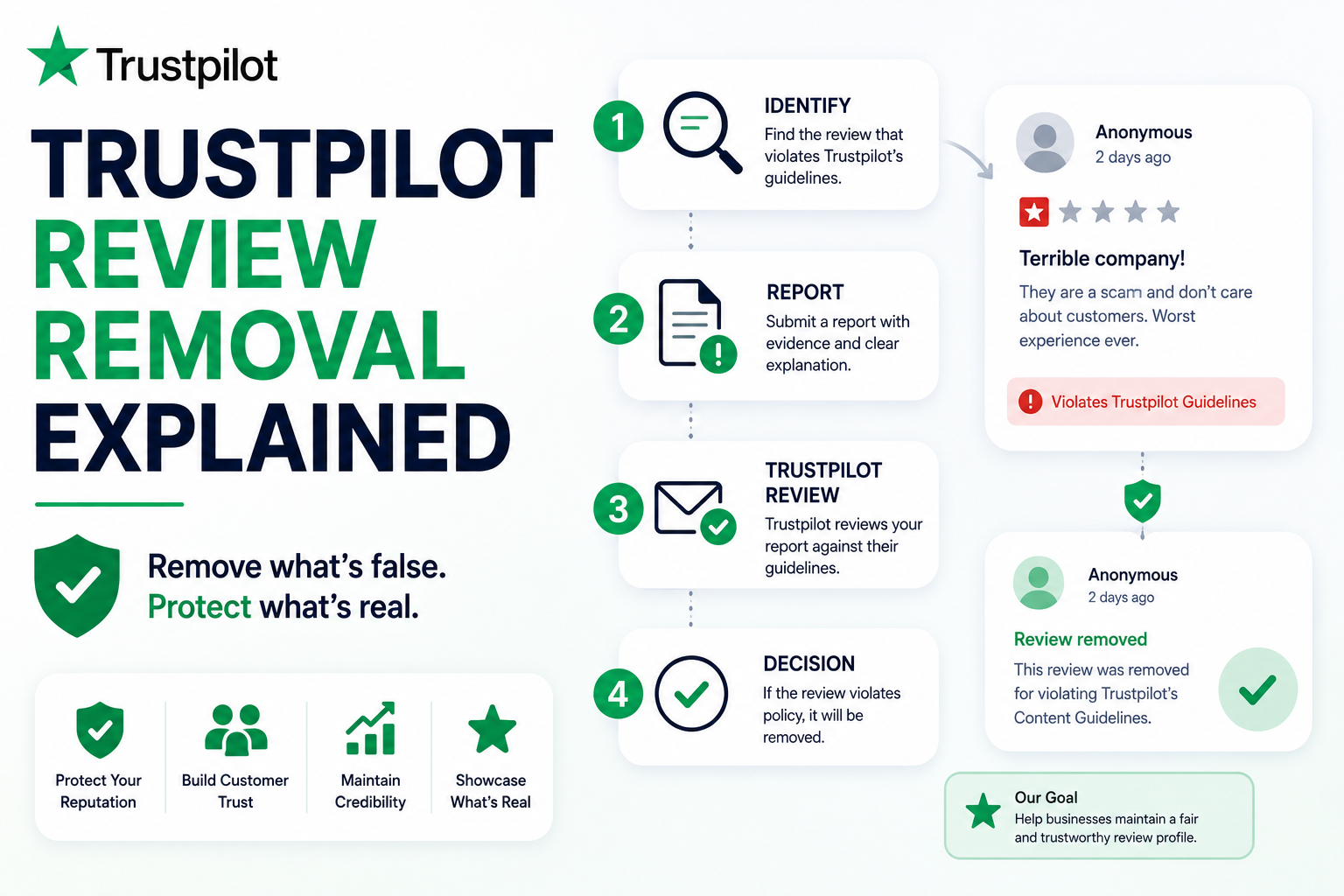
Trustpilot is one of the most used review platforms for businesses and customers. Many people check Trustpilot before buying from a company, using a service, or trusting an online brand. Because of this, reviews on Trustpilot can strongly affect customer confidence, sales, and brand reputation.
Sometimes, a business may receive a review that feels unfair, fake, harmful, or misleading. In such cases, the business may want the review removed. However, Trustpilot does not remove reviews only because they are negative. A review must violate Trustpilot’s guidelines before it can be removed.
This article explains how Trustpilot review removal works, what types of reviews may be removed, and what businesses should do when a review stays online.
What Is Trustpilot Review Removal?
Trustpilot review removal means reporting a review to Trustpilot and asking the platform to remove it because it breaks the rules.
Businesses cannot directly delete reviews from their Trustpilot profile. They can only flag or report reviews that they believe violate Trustpilot’s guidelines. Trustpilot then reviews the case and decides whether the review should stay, be edited, or be removed.
This process helps protect both customers and businesses. Customers can share honest experiences, while businesses can report reviews that are fake, abusive, spammy, or policy-violating.
Can Businesses Delete Trustpilot Reviews?
No. Businesses cannot delete Trustpilot reviews by themselves. This is important because Trustpilot is designed to show independent customer feedback.
If businesses could remove every negative review, customers would not trust the platform. That is why Trustpilot controls the review removal process.
A business can report a review, explain the issue, and provide supporting details. But Trustpilot makes the final decision.
Why Trustpilot Does Not Remove Every Negative Review
A negative review is not automatically a rule violation. Customers are allowed to share poor experiences if the review is honest and follows platform rules.
For example, a customer may write that delivery was late, support was slow, or the product did not meet expectations. These reviews may be negative, but they can still be allowed if they are based on a real experience.
Trustpilot usually removes reviews only when they break guidelines, not when they simply damage a company’s image.
What Types Of Trustpilot Reviews Can Be Removed?
A Trustpilot review may be removed if it violates platform rules. Common reasons include fake experiences, harmful content, personal information, spam, conflicts of interest, or wrong company reviews.
1. Fake Or Non-Genuine Reviews
A review may be removed if the reviewer did not have a real experience with the business. Trustpilot may ask the reviewer to provide proof of experience, such as an order number, invoice, email, booking confirmation, or other supporting details.
If the reviewer cannot prove the experience, the review may be removed.
2. Reviews With Personal Information
Reviews should not include private details such as phone numbers, addresses, email IDs, payment details, medical details, or sensitive personal data.
If a review exposes private information, Trustpilot may ask the reviewer to edit it or may remove the review.
3. Offensive Or Harmful Content
Reviews that include threats, hate speech, harassment, discrimination, or abusive language may violate Trustpilot’s rules.
Strong criticism may be allowed, but harmful or threatening content may not be.
4. Spam Or Promotional Content
Reviews that include advertisements, promotional links, repeated text, irrelevant content, or marketing messages may be considered spam.
Spam reviews do not help customers make informed decisions and may be removed.
5. Conflict Of Interest Reviews
A review may be removed if it is written by someone with a conflict of interest. This may include competitors, employees, former employees, business owners, or people paid to leave reviews.
Reviews should come from real customers with genuine experiences.
6. Wrong Company Reviews
Sometimes customers accidentally review the wrong business. If the review clearly refers to another company, Trustpilot may remove it or move it to the correct profile.
7. Reviews That Need Editing
Some reviews may not need full removal. If only one part of the review violates rules, Trustpilot may ask the reviewer to edit it.
For example, if a review includes a personal phone number, the reviewer may be asked to remove that detail. If edited properly, the review may stay online.
Quick Overview
| Review Issue | Possible Trustpilot Action |
|---|---|
| Fake experience | May ask reviewer for proof |
| Personal information | May ask for edit or remove review |
| Threats or hate speech | May remove review |
| Spam or links | May remove review |
| Wrong company | May remove or move review |
| Genuine negative opinion | Usually remains online |
How To Report A Trustpilot Review
If you believe a review violates Trustpilot’s rules, follow a clear process.
Step 1: Read The Review Carefully
First, check whether the review actually breaks a rule. Do not report a review only because it is negative or uncomfortable.
Look for clear issues such as fake experience, personal information, abuse, spam, wrong company details, or conflict of interest.
Step 2: Collect Evidence
Save the review details before reporting. This may include:
- Screenshot of the review
- Review URL
- Reviewer name
- Date posted
- Order records
- Customer communication
- Proof that the reviewer is not a customer
- Proof of wrong company details
- Evidence of spam or repeated content
Evidence can help if you need to explain the issue clearly.
Step 3: Flag The Review
Use Trustpilot’s business account tools to flag the review. Choose the most accurate reason for reporting.
Avoid vague reasons like “This review is unfair.” Instead, select the reason that matches the policy issue.
Step 4: Explain The Issue Clearly
Keep your explanation factual and simple.
Example:
“We cannot match this reviewer to any customer record, order number, or support ticket. The review also mentions a product we do not sell.”
Another example:
“This review includes a customer service agent’s personal phone number, which appears to violate privacy rules.”
Step 5: Wait For Trustpilot’s Decision
Trustpilot will review the report. In some cases, they may contact the reviewer and ask for proof or edits.
If the reviewer provides proof and the review follows the rules, it may stay online. If the reviewer does not respond or cannot support the review, it may be removed.
What If Trustpilot Does Not Remove The Review?
If Trustpilot keeps the review online, it usually means the review does not clearly violate the rules or the reviewer provided enough proof.
In this case, the best option is to respond professionally. A calm and helpful response can reduce the damage and show future customers that your business cares.
Example response:
“Thank you for your feedback. We are sorry to hear about your experience. We take customer concerns seriously and would like to understand what happened. Please contact our support team so we can review this further.”
Why Responding Matters
Many customers read business replies before making a decision. A professional response can improve trust, even when the review is negative.
A good response shows that your business listens, cares, and is willing to solve problems.
Avoid arguing, blaming, or using emotional language. Keep the reply polite and helpful.
What Businesses Should Not Do
Businesses should avoid actions that can harm their reputation or violate rules.
Do not:
- Report every negative review
- Attack the reviewer
- Reveal customer details
- Post fake positive reviews
- Ask employees to write fake reviews
- Offer rewards only for positive reviews
- Threaten legal action publicly
- Copy-paste the same reply to every review
- Ignore repeated complaints
These actions can make the business look unprofessional.
How To Build A Strong Trustpilot Profile
Review removal is only one part of reputation management. Businesses should also focus on building a strong and honest review profile.
Useful steps include:
- Ask real customers for honest reviews
- Respond to reviews regularly
- Fix repeated customer complaints
- Keep customer records organized
- Report only clear policy violations
- Use feedback to improve service
- Monitor reviews weekly
- Train support teams to handle complaints
- Keep communication professional
- Avoid fake or paid reviews
A strong profile with many genuine reviews can reduce the impact of unfair or negative feedback.
When Legal Help May Be Needed
If a Trustpilot review includes serious false claims, defamation, threats, or confidential information, legal advice may be useful.
A lawyer can help decide whether a legal notice, platform escalation, or court order is appropriate.
However, legal action should be used carefully. Many negative reviews are opinions, and opinions may be allowed depending on the situation and law.
FAQs
1. Can a business remove a Trustpilot review directly?
No. A business cannot directly delete a Trustpilot review. It can only report the review if it believes the review violates Trustpilot’s guidelines.
2. Does Trustpilot remove negative reviews?
Trustpilot does not remove reviews only because they are negative. A review must break platform rules to be removed.
3. What happens if a reviewer cannot prove their experience?
If Trustpilot asks for proof and the reviewer cannot provide it, the review may be removed.
4. Can a review be edited instead of removed?
Yes. If only part of the review violates rules, Trustpilot may ask the reviewer to edit it. If the issue is fixed, the review may remain online.
5. What should a business do if Trustpilot keeps the review online?
The business should respond professionally, address the concern, and continue building genuine positive reviews.
Final Thoughts
Trustpilot review removal is possible, but only when a review violates platform guidelines. Businesses cannot delete reviews directly, and negative reviews may stay online if they are genuine and policy-compliant.
The best approach is to report clear violations with evidence, respond professionally to allowed reviews, and build a strong review profile with genuine customer feedback.
By handling Trustpilot reviews carefully, businesses can protect their reputation, improve customer trust, and create a more balanced online presence.



Leave a Reply