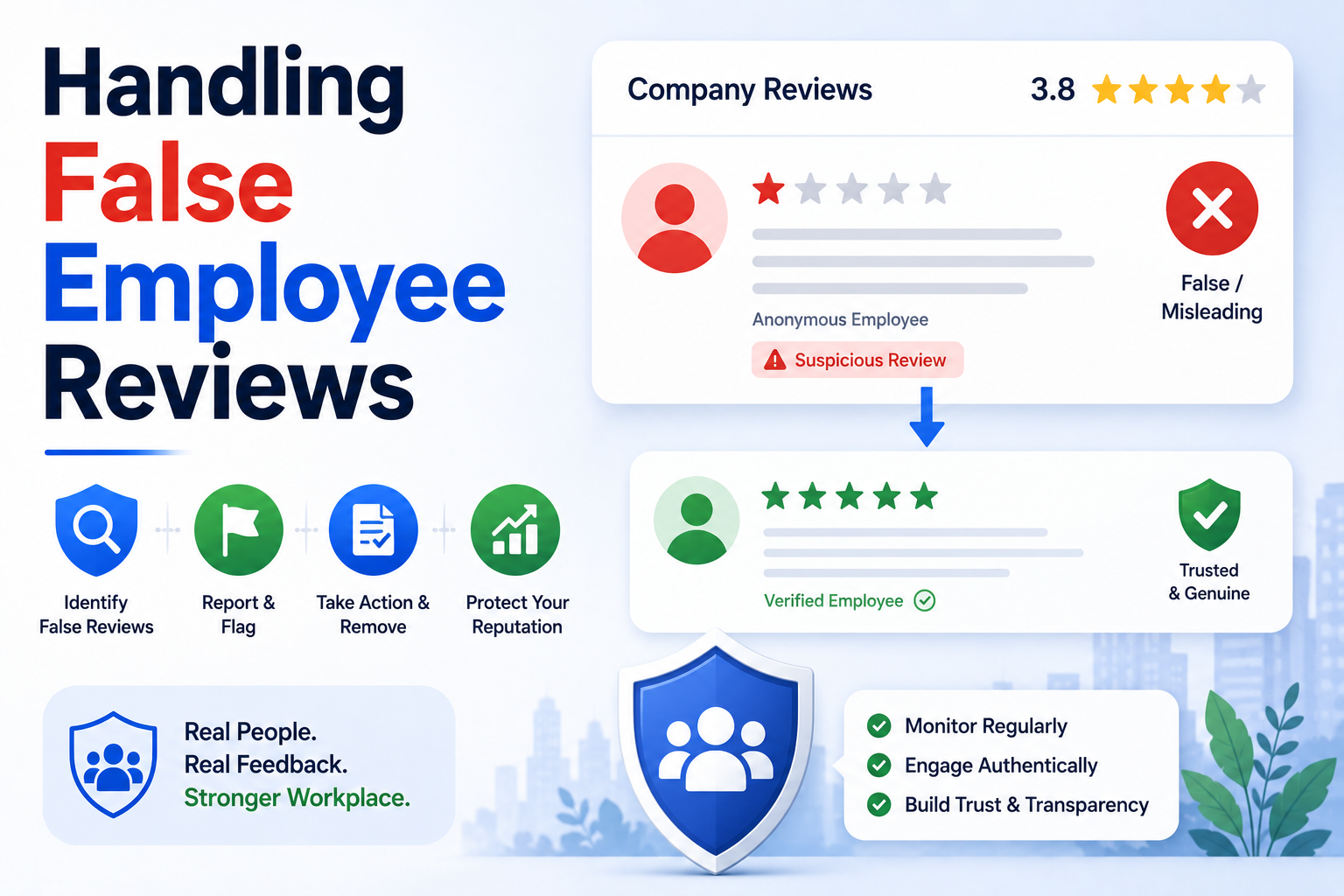
Employee reviews can strongly influence how people see a company as a workplace. Job seekers often read reviews before applying. Current employees may compare their experiences with public feedback. Investors, partners, and customers may also notice workplace reputation. Because of this, false employee reviews can create serious problems for a company.
A false employee review is a review that includes inaccurate, misleading, fake, or harmful claims about a workplace. It may be posted by someone who never worked at the company, a competitor, a disgruntled former worker, or a person using a fake identity.
Handling false employee reviews requires a careful and professional approach. Companies should not react emotionally. Instead, they should verify the review, collect evidence, report policy violations, and respond in a way that protects the employer brand.
What Are False Employee Reviews?
False employee reviews are workplace reviews that do not reflect a real or accurate employee experience. These reviews may appear on platforms like Glassdoor, Indeed, AmbitionBox, Comparably, Google, Facebook, or other employer review websites.
A review may be false if it comes from someone who never worked at the company, includes claims that are clearly untrue, reveals confidential information, or describes events that never happened.
However, not every negative employee review is false. A former employee may share a genuine negative experience. If the review is based on personal opinion and does not break platform rules, it may remain online.
Why False Employee Reviews Matter
False employee reviews can damage employer reputation. They may discourage good candidates from applying and create doubt about company culture.
They can affect:
- Hiring and recruitment
- Candidate trust
- Employee morale
- Company image
- Leadership reputation
- Investor confidence
- Customer perception
- Internal culture
- Online search results
If a false review ranks high on Google or appears on a popular employer review platform, it can influence many people.
Common Signs Of A False Employee Review
False reviews often have warning signs. These signs do not always prove that a review is fake, but they can help you investigate.
Common signs include:
- Reviewer mentions a role that does not exist
- Review describes a location your company does not have
- Claims do not match company records
- Reviewer uses very generic language
- Review includes extreme accusations without details
- Multiple similar reviews appear suddenly
- Review includes confidential information
- Review mentions services or departments you do not operate
- Reviewer appears connected to a competitor
- Review is copied from another website
- Review includes personal attacks or threats
Before taking action, check the facts carefully.
Negative Review vs False Review
It is important to separate genuine negative reviews from false reviews. A negative review may be written by a real employee who had a poor experience. A false review may be written by someone who did not work there or who includes misleading claims.
Key Points
| Review Type | Meaning | Best Action |
|---|---|---|
| Negative employee review | Real employee shares poor experience | Respond professionally |
| False employee review | Claims are fake or misleading | Report with evidence |
| Abusive review | Contains threats or harassment | Report to platform |
| Confidential review | Reveals private company details | Request removal |
| Opinion-based review | Personal workplace opinion | Usually cannot be removed |
Step 1: Stay Calm And Avoid Public Arguments
The first step is to stay calm. A false review can feel frustrating, but an emotional response can make the company look unprofessional.
Do not attack the reviewer publicly. Do not reveal employee records. Do not write defensive or angry replies. Remember that future candidates will read both the review and your response.
A calm response can protect your company image.
Step 2: Verify The Review Internally
Check whether the reviewer could be a real employee or former employee. Look at the details mentioned in the review, such as job title, department, location, timeline, manager name, or workplace event.
Compare the claims with HR records, exit interviews, complaint logs, payroll records, or internal communication.
The goal is not to identify the reviewer publicly. The goal is to understand whether the review appears genuine, mistaken, exaggerated, or false.
Step 3: Document Everything
Before reporting the review, collect evidence.
Save:
- Screenshot of the review
- Review URL
- Date posted
- Platform name
- Reviewer name or username
- Specific false claims
- Internal records that disprove the claims
- Proof of wrong company, wrong location, or wrong role
- Evidence of competitor connection if available
Good documentation helps if you need to submit a dispute, appeal, or legal request.
Step 4: Check Platform Guidelines
Each review platform has its own rules. Glassdoor, Indeed, Google, Facebook, and other platforms may handle disputes differently.
Most platforms may remove reviews that include:
- Fake experiences
- Hate speech
- Threats
- Harassment
- Personal information
- Confidential information
- Spam
- Conflicts of interest
- Wrong company reviews
- Defamatory content
Read the platform’s guidelines before reporting. This helps you choose the correct reason.
Step 5: Report The Review
Use the platform’s official reporting or flagging process. Select the most accurate policy violation.
For example:
- Choose “not a genuine experience” if the reviewer never worked there
- Choose “personal information” if the review exposes private details
- Choose “harassment” if it includes threats or abuse
- Choose “confidential information” if it reveals internal data
- Choose “wrong company” if the review refers to another employer
Keep your explanation short and factual.
Example:
“This review appears to refer to another company. It mentions a branch in Mumbai and a sales department, but our company does not operate in Mumbai and does not have that department.”
Step 6: Respond Professionally If The Review Stays Visible
Sometimes platforms may not remove the review immediately. In that case, consider posting a professional response.
Example:
“Thank you for sharing your feedback. We take workplace concerns seriously. However, we are unable to verify the details mentioned in this review based on the information provided. We encourage current or former employees to contact HR directly so we can review concerns through the proper process.”
This response is calm, professional, and does not reveal private information.
Step 7: Avoid Revealing Employee Information
Never share private employee details in a public response. Even if you believe the review is false, do not mention names, employment dates, disciplinary issues, salary details, or internal HR matters.
Publicly exposing private information can create legal and reputation risks.
Step 8: Use Legal Support For Serious Cases
If a review includes serious false accusations, defamation, threats, confidential data, or harmful claims, legal advice may be needed.
A lawyer may help with:
- Defamation assessment
- Legal notice
- Platform escalation
- Court order
- Confidentiality breach
- Data privacy concerns
Legal action should be used carefully and only when the issue is serious.
How To Protect Employer Reputation
False reviews should be handled, but long-term reputation depends on building a strong employer brand.
Useful steps include:
- Encourage honest employee feedback
- Improve internal communication
- Conduct employee surveys
- Respond to reviews professionally
- Keep employer profiles updated
- Highlight company culture
- Share employee stories
- Address repeated complaints
- Train managers
- Improve onboarding and exit processes
- Monitor employer review platforms regularly
A strong employer brand can reduce the impact of false or unfair reviews.
What Not To Do
Avoid these mistakes:
- Do not attack the reviewer
- Do not reveal employee identity
- Do not post fake positive reviews
- Do not pressure employees to leave positive reviews
- Do not report every negative review
- Do not ignore repeated workplace complaints
- Do not respond emotionally
- Do not threaten legal action publicly
- Do not copy-paste the same response to every review
These actions can damage trust and make the company look defensive.
FAQs
1. Can false employee reviews be removed?
Yes, if they violate the platform’s policies. Reviews that are fake, abusive, confidential, or unrelated may be eligible for removal.
2. Can a company delete employee reviews directly?
No. Most platforms do not allow companies to delete reviews directly. Companies can report reviews and request review by the platform.
3. What if the review is negative but true?
If the review is based on a real employee experience and follows platform rules, it may stay online. The best response is to reply professionally and improve internal issues.
4. Should a company respond to false employee reviews?
Yes, if the review remains visible. The response should be calm, factual, and professional without revealing private employee information.
5. When should legal action be considered?
Legal action may be considered when the review includes serious false claims, defamation, threats, confidential information, or harmful accusations.
Final Thoughts
Handling false employee reviews requires patience, evidence, and professionalism. The goal is not to remove every negative comment but to address reviews that are fake, misleading, abusive, or policy-violating.
Start by verifying the review, documenting the issue, checking platform rules, and reporting it through the correct process. If the review stays online, respond calmly and protect employee privacy.
At the same time, build a strong employer brand through honest communication, better workplace practices, and regular reputation monitoring. A healthy employer reputation can reduce the impact of false reviews and help attract better talent.

Leave a Reply