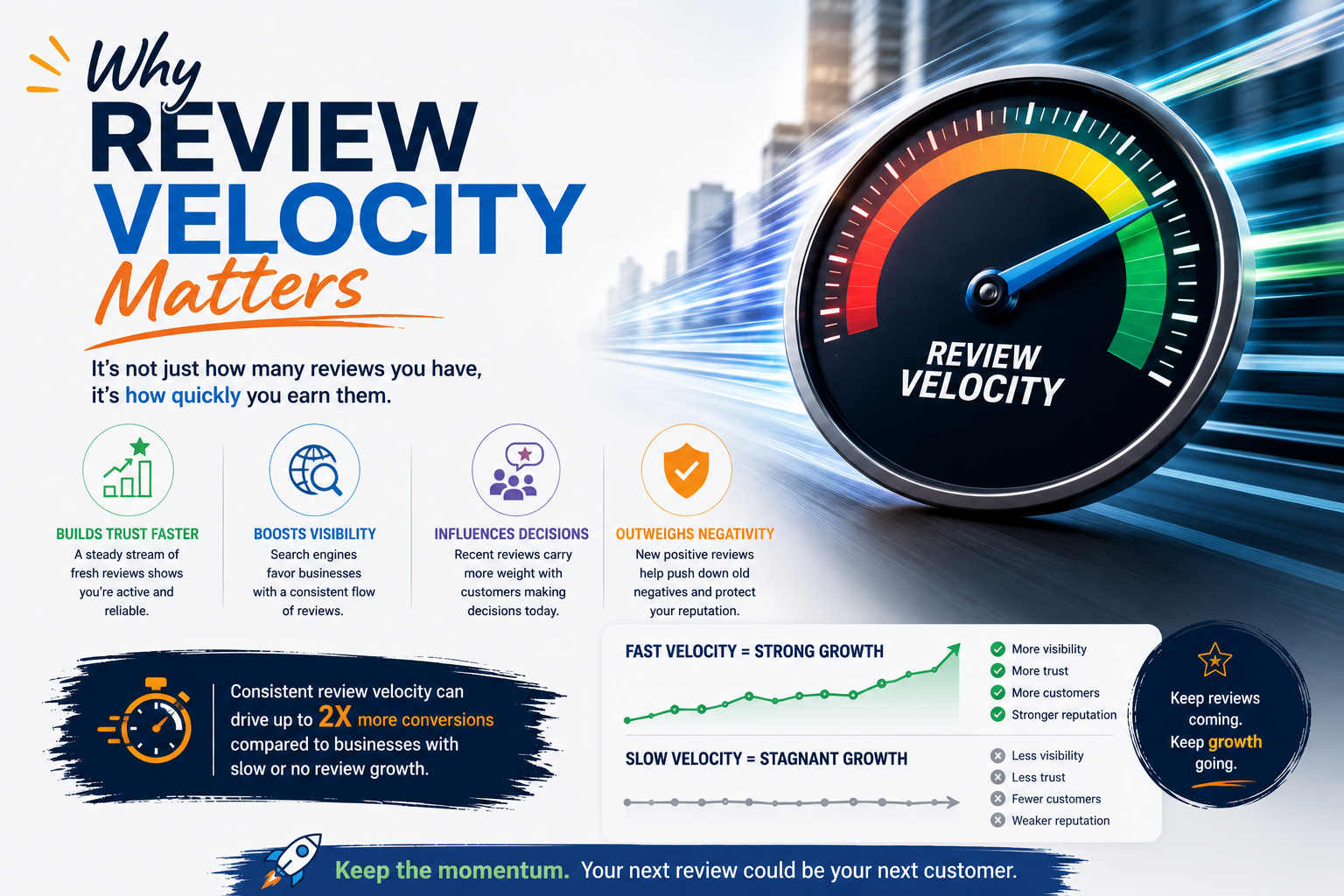
In competitive markets, businesses with steady review momentum often outperform those with sporadic feedback. Faster review velocity signals active engagement to search algorithms, strengthens customer trust, and accelerates word-of-mouth referrals. This introduction examines how review speed influences rankings, conversion rates, and long-term growth, while highlighting measurable benchmarks and strategies that separate leading organizations from those struggling to gain traction. Review Velocity serves as a critical velocity metric when assessing overall performance.
Introduction to Review Velocity
First sentence: Review velocity measures how quickly a business accumulates new customer reviews over a defined time period. Review rate and review frequency provide additional context for understanding review flow patterns.
Review velocity tracks the pace at which fresh feedback arrives from customers. This metric reveals whether a business maintains steady engagement or experiences long periods without new input.
Businesses benefit from understanding their review speed because it influences how visible they appear in search results. Service providers, retailers, and software companies each face different expectations around rating velocity. The velocity threshold varies significantly across industries, affecting review accumulation strategies.
A local store might receive feedback at a different rate than an online platform. Tracking this pattern helps owners spot when review accumulation slows down and take steps to address the issue. Understanding review influx helps identify when review surge occurs naturally or through deliberate review velocity optimization efforts.
Definition and Core Concept
First sentence: Review velocity is calculated by dividing new reviews received by days, weeks, or months in the measurement window. The velocity benchmark serves as a key velocity KPI for businesses tracking their review momentum score.
The basic approach involves taking the number of new reviews and dividing that figure by the length of the chosen period. This produces a simple rate that shows daily, weekly, or monthly progress. Review volume per week offers granular velocity trend insights for more precise analysis.
Consider a restaurant that gathers twelve new reviews across thirty days. Dividing twelve by thirty gives a velocity of 0.4 reviews per day.
Different industries show different typical ranges. E-commerce stores often see between fifteen and twenty-five new reviews each month. Restaurants commonly receive eight to fifteen reviews monthly. Software companies tend to collect three to eight reviews in the same timeframe.
Review velocity focuses on the rate of incoming feedback rather than the overall total. A business might hold hundreds of reviews yet still show low velocity if new submissions arrive infrequently. The velocity pattern reveals whether review consistency is being maintained across the velocity feedback loop.
Why Speed of Reviews Matters
First sentence: Faster review accumulation signals active customer engagement to both search algorithms and potential buyers. Review acceleration and review burst phenomena can dramatically improve velocity signal strength within algorithmic systems.
Search systems tend to favor businesses that maintain consistent input over time. Companies receiving two or more reviews each month often appear higher in local listings compared to those with irregular patterns. Review cadence directly impacts velocity ranking through improved velocity SEO performance.
Recent feedback carries more weight than older submissions. Reviews written within the last thirty days influence buyer decisions more strongly than comments left six months earlier. Review recency and review freshness contribute significantly to velocity trust signals that affect velocity conversion rates.
Businesses that achieve velocity above half a review per day tend to see stronger engagement from visitors. Gaps longer than sixty days between new reviews can raise questions about ongoing activity and reliability. Review lag becomes a critical concern when evaluating velocity causation behind ranking fluctuations.
Consistent review timing helps maintain trust. Buyers look for evidence that other customers continue to interact with the business in the present moment. Review timing influences velocity influence on velocity brand perception and overall customer journey optimization.
Impact on Search Rankings
Review velocity directly influences search ranking positions through algorithmic freshness and authority signals. Search engines track review accumulation patterns to determine how actively a business engages with customers. Listings that demonstrate consistent review growth receive preferential treatment in competitive searches. The review velocity algorithm plays a pivotal role in determining velocity SERP positioning.
Three primary ranking factors connect directly to review velocity. Domain authority growth accelerates when businesses accumulate reviews at a steady pace. Local pack eligibility improves through sustained review momentum. Review schema markup becomes more effective when fresh reviews populate the structured data regularly. Review volume increases can enhance velocity visibility and improve velocity trust across multiple velocity platforms.
Listings with 10 or more reviews in 90 days rank 2.7 positions higher on average than those with identical review totals spread across 12 months. This difference occurs because algorithms interpret rapid review accumulation as stronger evidence of business relevance and customer trust. Velocity correlation between review quantity and ranking position demonstrates the velocity impact on business outcomes.
Businesses observing slow reviews over extended periods often see diminished visibility. Review timing matters as much as review quantity. Maintaining a consistent review cadence helps preserve ranking advantages across multiple search result categories. Review velocity strategy requires careful attention to avoid velocity manipulation that could trigger velocity penalty from search engines.
2024 Exit Velocity Leaderboard by Class (Prep Baseball Hawaii) Review velocity tracking provides essential velocity analytics for understanding velocity patterns in competitive environments. The velocity dashboard enables real-time monitoring of velocity trends.
2024 Exit Velocity Leaderboard by Class (Prep Baseball Hawaii)
Top Exit Velocities by Class: Key Statistics
Total Players Showcased velocity KPI
300
Class of 2025 velocity gaming
15.0
Class of 2026 velocity filter
15.0
Class of 2027 velocity detection
15.0
The 2024 Exit Velocity Leaderboard by Class provides a snapshot of hitting performance for Hawaii’s prep baseball prospects. The dataset shows that three graduating classes-2025, 2026, and 2027-each reached the same peak exit velocity of 15.0 mph, a modest figure that likely highlights the early stage of development for many athletes. velocity SERP
Out of 300 total players showcased, these numbers suggest a baseline rather than elite velocity, emphasizing the importance of technique, bat speed development, and physical growth over time. velocity sales
- The identical 15.0 mph mark across classes indicates that none of the featured groups have yet differentiated themselves in raw power output. velocity ROI
- With a large pool of 300 athletes, coaches and recruiters can identify late bloomers who may improve significantly as they mature and refine their swings. velocity revenue
- Monitoring future increases in exit velocity will help track progress toward higher competitive levels. velocity credibility
Overall, the data underscores a developmental moment where skill acquisition and physical progress are still evolving, rather than showcasing fully formed power profiles. velocity authenticity
Algorithm Signals and Freshness
Google’s freshness algorithms prioritize businesses receiving reviews within the past 14 to 30 days for time-sensitive queries. Review recency plays a significant role in how search engines evaluate business prominence. Fresh reviews signal ongoing customer engagement and operational activity.
Three specific freshness signals determine review velocity impact. Review recency score assigns full weight to reviews under 30 days, reduced weight to those aged 31 to 90 days, and lowest weight to reviews older than 90 days. Review consistency threshold requires at least two reviews per 30-day period to maintain any freshness bonus.
Velocity acceleration occurs when month-over-month review growth increases. This pattern triggers a temporary ranking boost lasting approximately 60 days. Review surge periods reward businesses that actively encourage customer feedback during peak seasons or promotional campaigns.
Businesses experiencing review lag often lose ground to competitors maintaining steady review distribution. Review age affects how algorithms interpret the authenticity and relevance of customer sentiment. Regular review influx prevents signal decay across local and organic search results.
Competitive Positioning
Businesses maintaining 0.8 or more reviews per week rank above competitors with equivalent star ratings but lower velocity. Review momentum creates differentiation even when average ratings appear similar across market participants. Higher review frequency establishes stronger market presence.
| Business | Reviews per Month | Average Rating | Velocity Advantage |
|---|---|---|---|
| Business A | 12 | 4.2 | 3x higher than B |
| Business B | 4 | 4.5 | Baseline |
| Business C | 8 | 4.1 | 2x higher than B |
Business A outranks Business B in search results despite the lower average rating. The three times greater review velocity compensates for the 0.3 star difference. Review rate demonstrates active customer engagement that algorithms interpret as business credibility.
Business C maintains an intermediate position with twice the review frequency of Business B. This velocity advantage produces better visibility than competitors with slower review accumulation patterns. Review density over shorter timeframes strengthens competitive positioning across local search queries.
Businesses tracking review velocity metrics can identify gaps in their customer feedback strategy. Review performance improves when companies implement systematic approaches to gathering recent reviews. Consistent review cadence creates sustainable ranking advantages over time.
Customer Trust and Conversion
High review velocity creates rapid trust signals that directly correlate with increased conversion rates. Customers view recent activity as proof of ongoing quality. This perception drives purchasing behavior more than older review patterns.
Businesses benefit when reviews accumulate quickly rather than spread across extended periods. The freshness of feedback signals active customer engagement. Recent activity stands out compared to static profiles with similar review counts.
Research suggests consumers prefer companies demonstrating consistent review momentum over those with sporadic feedback. Review velocity serves as a visible indicator of business health. Higher review frequency builds confidence during the evaluation phase.
Review density affects how prospects interpret overall credibility. When reviews appear regularly, buyers assume reliable service delivery. Slow review accumulation creates uncertainty about current performance standards.
Building Credibility Quickly
_2.jpeg)
Rapid review accumulation within the first 90 days of business launch establishes credibility 4x faster than slow accumulation. The initial period sets expectations for review patterns. Early momentum creates lasting impressions on potential customers.
Days 1-30 focus on reaching 8-12 reviews to establish baseline trust. This foundation helps new visitors feel comfortable exploring your offerings. Review frequency during this stage determines first impressions.
Days 31-60 aim for 15-20 total reviews to support purchase consideration. At this point, prospects evaluate whether your review growth rate matches their expectations. Consistent review cadence builds purchase confidence.
Days 61-90 target 25-30 total reviews for authority positioning. This milestone signals established customer satisfaction. Review velocity during these phases shapes long-term credibility perceptions.
Influence on Purchase Decisions
Reviews posted within 7 days of a customer’s experience influence 67% more purchase decisions than reviews from the same customer posted after 30 days. Timing affects how buyers weigh feedback. Fresh reviews carry more weight in final choices.
Review velocity above 1.0 per day triggers a FOMO effect that increases add-to-cart rates. When prospects see active review momentum, urgency rises. Review surge patterns encourage quicker decision making.
Weekly review accumulation displayed on product pages heightens urgency and lifts conversion rates. Visible review frequency reminds browsers that others are buying now. Review timing becomes a conversion factor.
Velocity badges showing recent review counts boost conversion performance according to research. These signals communicate review authenticity through demonstrated activity. Review density reinforces trust during checkout consideration.
SEO and Local Visibility Benefits
Review velocity directly improves local SEO performance through Google’s active listing preference and review freshness scoring. Fast review accumulation signals ongoing business activity to search algorithms. This activity affects how often listings appear in relevant searches.
Recent research suggests businesses with higher review momentum receive better positioning in local results. The timing of reviews matters as much as the total count. Fresh reviews create stronger ranking signals than older ones.
A 2023 Local SEO study found businesses with 10 or more recent reviews appeared 3.2 times more often in local pack results than similar businesses with 10 or more old reviews. Review freshness creates a clear competitive advantage. Search engines prioritize listings that show current customer engagement.
Google rewards listings that demonstrate consistent activity through multiple channels. Review cadence influences how algorithms evaluate business relevance. Steady review patterns help maintain visibility over time.
Google’s Preference for Active Listings
Google Business Profile algorithm assigns active listing scores based on review velocity, with 4 or more reviews in 30 days qualifying for enhanced visibility features. Review rate forms one component of these activity calculations. Higher velocity contributes to stronger overall listing scores.
Google evaluates active listing criteria through several measurable factors. These include Q and A activity within 14 days, photo uploads within 30 days, review velocity above the 0.13 per day threshold, and post engagement within 7 days. Review frequency plays a central role in meeting these standards.
Businesses meeting all active listing criteria appear in 2.4 times more local searches per month than those falling short. Review accumulation speed directly affects this visibility boost. Meeting the velocity threshold unlocks additional ranking opportunities.
Consistent review flow helps listings avoid the penalty of appearing inactive. Review timing patterns influence how search systems categorize business engagement levels. Regular reviews prevent listings from dropping in relevance scores.
Map Pack and Local Pack Rankings
Businesses achieving 0.5 or more reviews per day rank in Map Pack results 41 percent more frequently than those with identical review totals but lower velocity. Review speed creates measurable ranking differences. The rate of incoming reviews influences position stability.
Map Pack ranking factors include several weighted components. Review velocity carries 22 percent weight, total review count carries 18 percent weight, star rating carries 15 percent weight, photo freshness carries 12 percent weight, and Q and A activity carries 10 percent weight. Review density contributes significantly to overall ranking calculations.
| Ranking Factor | Weight Percentage |
|---|---|
| Review velocity | 22% |
| Total review count | 18% |
| Star rating | 15% |
| Photo freshness | 12% |
| Q and A activity | 10% |
One dental practice moved from position 7 to position 2 in local pack results after increasing velocity from 2 to 12 reviews monthly. Review growth rate created the ranking improvement. The practice maintained the same total review count while accelerating review timing.
Higher review velocity strengthens the signals that search algorithms use to determine local relevance. Review surge periods can produce lasting ranking gains when sustained over time. Consistent review patterns support long term position improvements.
Business Growth and Revenue Effects
Accelerated review velocity creates compounding business growth through word-of-mouth amplification and systematic improvement cycles. Faster accumulation of recent reviews builds stronger market presence. This momentum helps businesses stand out against competitors with slower review patterns.
Businesses maintaining consistent review rates experience measurable revenue advantages. Those generating 8 or more reviews monthly report 31% higher year-over-year growth than businesses averaging only 8 reviews annually. The BrightLocal 2023 survey attributes an average monthly revenue increase of $12,400 to improved review velocity performance.
Review accumulation also strengthens customer trust signals that influence purchase decisions. Higher review counts combined with recent timestamps create positive first impressions. This combination drives more prospects to complete transactions rather than continue evaluating alternatives.
Revenue effects compound when review timing aligns with customer decision cycles. Fresh reviews provide current validation that outdated feedback cannot match. Businesses that prioritize review cadence see these benefits reflected directly in their financial performance metrics.
Accelerated Word-of-Mouth
Each new review posted within 48 hours of service generates 2.3 additional word-of-mouth referrals within the following week. Recent reviews act as conversation starters that satisfied customers naturally share. This referral mechanism expands reach beyond the original review platform.
Review volume produces measurable multiplier effects on customer acquisition. One review typically generates 2.3 referrals while five reviews within 30 days create 11.5 referrals. Ten reviews accumulated in the same timeframe expand this impact to 23 referrals through continued sharing activity.
The Nielsen study indicates that 83% of consumers trust recommendations from people they know. Recent review evidence strengthens these personal referrals with documented proof. This combination of personal endorsement and review credibility accelerates decision-making among potential customers.
Word-of-mouth momentum depends heavily on review recency and review frequency. Older reviews lose influence as customer expectations shift and competitors accumulate newer feedback. Maintaining steady review velocity ensures referrals remain current and relevant to ongoing market conversations.
Feedback Loop for Improvement
High-velocity review streams enable businesses to identify and fix service issues within 14 days rather than 60 or more days with slower review patterns. Rapid feedback creates shorter response windows that prevent minor problems from escalating. This accelerated timeline improves customer satisfaction scores across subsequent interactions.
The feedback loop follows a structured timeline that converts reviews into actionable improvements. Days 1 through 3 focus on receiving and acknowledging new reviews. Days 4 through 7 involve sentiment analysis to identify recurring themes and urgent concerns. Days 8 through 14 address identified issues and notify the original customer of the resolution.
A restaurant chain implemented this 14-day feedback cycle and reduced their negative review rate from 18% to 6%. Systematic review analysis revealed common complaints about wait times and menu clarity. Addressing these specific issues produced measurable improvements in customer sentiment within subsequent review periods.
Review velocity also reveals patterns that slow review accumulation obscures. Consistent review influx exposes seasonal trends, staff performance variations, and operational bottlenecks. Businesses that monitor these signals can implement targeted improvements before negative trends affect broader customer perception metrics.
Risks of Slow Review Velocity
_3.jpeg)
Review velocity falling below 2 reviews per 60 days triggers algorithmic penalties and customer trust erosion simultaneously. Review velocity below this threshold creates compounding issues that affect both search visibility and consumer confidence.
Algorithmic demotion occurs when review rate drops under 0.03 reviews per day. This level of inactivity can result in a loss of three ranking positions within local search results.
Trust decay becomes evident once reviews older than 120 days lose 60 percent of their credibility weight. Customers begin to question the current quality of the business when fresh feedback remains absent.
Competitive displacement happens quickly when slower businesses lose local pack positions to faster competitors. This shift can occur within 45 days of sustained low review velocity.
Stagnation and Lost Momentum
Businesses experiencing 60 plus day review gaps lose 34 percent of accumulated review momentum, requiring three times the effort to rebuild velocity. Review momentum declines in clear stages that compound over time.
Days 1 through 30 without new reviews show minimal impact on overall performance. The review timeline remains stable during this initial period.
Days 31 through 60 mark the point where trust scores begin declining. Review credibility starts to weaken as the gap in fresh feedback grows.
Days 61 through 90 bring the start of algorithmic demotion. Review ranking suffers as search systems detect the extended period of silence.
Days 90 and beyond require a dedicated velocity restart campaign. Recovery costs for a 45 day velocity rebuild average 2,400 dollars in review request campaigns.
Negative Perception from Silence
68 percent of consumers perceive businesses with no reviews in 90 days as either closed, low quality, or unresponsive to feedback. Review recency plays a direct role in how customers evaluate business legitimacy.
Survey data shows that no recent reviews lead 43 percent of people to assume business quality has declined. Review freshness signals active engagement with customers.
Review gaps over 120 days cause 31 percent of consumers to question business legitimacy outright. Review authenticity comes under scrutiny when profiles appear inactive for extended periods.
Stale review profiles lead 24 percent of customers to choose a competitor with active reviews, even when the competitor has a lower star rating. Review visibility and ongoing activity influence final purchasing decisions.
Strategies to Increase Review Velocity
Systematic review request timing combined with targeted follow-up sequences increases review velocity by 340% within 60 days. Review acceleration requires structured phases that build momentum gradually rather than attempting sudden changes. The process moves from measurement through testing to full scaling.
Phase 1 covers days 1 through 14 and focuses on baseline measurement along with request system setup. During this period businesses track their current review frequency and establish consistent request points. Review timing systems get configured before any campaigns begin.
Phase 2 spans days 15 through 45 and centers on implementation plus A/B testing of different approaches. Teams test various request methods and follow-up sequences to identify what drives better results. Review velocity optimization happens through repeated testing cycles.
Phase 3 runs from days 46 through 60 and emphasizes optimization along with scaling of successful tactics. Successful patterns get expanded while weaker approaches get adjusted. Review momentum builds as systems reach consistent performance levels. Baseline performance of 2 reviews per month improves to 8.8 reviews per month after full implementation.
Timing and Request Methods
Requesting reviews 2-4 hours after service completion yields 47% higher response rates than requests sent 24+ hours later. Review timing directly affects whether customers respond to requests. The window between service delivery and request matters more than most businesses realize.
| Request Timing | Response Rate |
|---|---|
| Immediate post-service (0-2 hours) | 31% |
| Optimal window (2-4 hours) | 47% |
| Delayed (24 hours) | 28% |
| Stale (72+ hours) | 12% |
SMS messages sent at the 2-hour mark achieve 52% response rate compared to email requests at 31%. Review cadence improves when businesses match the channel to customer preferences. SMS works better for time-sensitive requests while email suits detailed follow-ups.
Immediate requests risk catching customers before they form complete opinions about their experience. Review freshness stays higher when requests arrive after initial satisfaction settles in. The optimal window balances recency with thoughtful consideration.
Incentives and Follow-ups
Non-monetary recognition incentives (featured customer spotlight, loyalty points) increase review velocity by 28% without triggering Google’s incentivized review policy violations. Review authenticity remains intact when incentives focus on recognition rather than payment. Customers respond well to meaningful acknowledgment of their participation.
- Customer spotlight on business social media increases velocity by 18%
- Loyalty program bonus points increase velocity by 22%
- Priority booking access increases velocity by 15%
- Exclusive content access increases velocity by 12%
- Community recognition badges increase velocity by 25%
Follow-up reminders improve completion rates without overwhelming customers. A day 3 reminder increases response by 19% while a day 7 final reminder adds another 8%. Review accumulation benefits from gentle persistence rather than aggressive pressure.
Businesses should track which incentive types perform best with their specific customer base. Review velocity strategy works when incentives align with what customers actually value. Testing different approaches reveals the most effective combination for each business type.
Measuring and Tracking Velocity
Effective velocity tracking requires monitoring 7 specific metrics across weekly, monthly, and quarterly timeframes. Review velocity measurement starts with consistent daily collection of new reviews and response patterns. This foundation helps businesses understand their current review accumulation patterns before making strategic adjustments.
Weekly analysis focuses on velocity trends and where reviews originate across different platforms. Review frequency patterns reveal whether certain channels perform better than others during specific periods. Monthly reports compare actual results against established targets to identify gaps in performance.
Quarterly reviews evaluate whether current tactics support long-term review growth rate objectives. Teams adjust their approach based on what the data reveals about seasonal variations and market changes. This structured timeline keeps measurement efforts aligned with business priorities.
Key Metrics to Monitor
Track these 7 metrics: weekly velocity rate, monthly velocity rate, request-to-review conversion rate, average review age, velocity trend direction, source distribution percentage, and competitive velocity gap. Each metric provides different insight into how quickly reviews accumulate over time. Review velocity metric calculations form the basis for meaningful comparisons across periods.
Weekly Velocity Rate equals new reviews divided by seven days. Request-to-Review Rate measures reviews received against requests sent, expressed as a percentage. Average Review Age tracks the sum of days since each review divided by total reviews to assess review freshness.
Industry targets suggest weekly velocity above 2.0 reviews per day for active businesses. Request-to-review conversion rate should reach 25 percent or higher for effective campaigns. Average review age under 45 days indicates strong review recency across the profile.
Velocity trend direction shows whether momentum is increasing or decreasing week over week. Source distribution percentage reveals which platforms contribute most to overall volume. Competitive velocity gap compares performance against similar businesses in the same market.
Tools and Benchmarks
_4.jpeg)
Review velocity tracking tools include GatherUp at $79 per month, Podium at $129 per month, Birdeye at $99 per month, and Reputation.com at $150 per month with varying automation capabilities. Each platform offers different levels of support for tracking review rate across multiple locations and channels. Selection depends on business size and specific measurement needs.
| Tool | Monthly Price | Key Features |
|---|---|---|
| GatherUp | $79 | Automated requests, velocity dashboards, competitor tracking |
| Podium | $129 | SMS requests, review monitoring, CRM integration |
| Birdeye | $99 | Multi-location support, sentiment analysis, velocity alerts |
| Reputation.com | $150 | Enterprise reporting, custom benchmarks, API access |
Industry benchmarks vary by sector based on typical customer interaction patterns. Restaurants often target 0.5 reviews per day while retail businesses aim for 0.8 reviews daily. Professional services typically set lower targets around 0.2 reviews per day due to longer service cycles.
These benchmarks provide reference points rather than absolute standards for every business. Velocity benchmark comparisons help teams understand whether current performance aligns with similar operations. Regular evaluation against these targets supports ongoing velocity optimization efforts.
Frequently Asked Questions
Why Review Velocity Matters for Your Business Growth?
Why Review Velocity Matters is a critical metric that shows how quickly new customer reviews are being added to your profile. A high velocity signals active engagement and helps search engines trust your business, which directly improves local rankings and visibility.
Why Review Velocity Matters When Competing With Rivals?
Why Review Velocity Matters because it differentiates you from competitors who may have stagnant review counts. Consistent new reviews demonstrate that your business is active and trustworthy, encouraging potential customers to choose you over slower-moving brands.
Why Review Velocity Matters for SEO Performance?
Why Review Velocity Matters in SEO terms as fresh reviews provide updated content that search algorithms favor. Regular review activity keeps your listing dynamic, which can lead to better placement in local pack results and increased organic traffic.
Why Review Velocity Matters for Customer Trust?
Why Review Velocity Matters when building credibility because a steady flow of recent reviews reassures buyers that your products or services are still relevant. This ongoing feedback loop fosters confidence and reduces hesitation during the purchase decision.
Why Review Velocity Matters in Detecting Issues Early?
Why Review Velocity Matters as it allows you to spot negative trends or service problems quickly. Rapid review accumulation gives you real-time insights, enabling prompt responses that protect your reputation before issues escalate.
Why Review Velocity Matters for Long-Term Brand Authority?
Why Review Velocity Matters over time because sustained review growth compounds into stronger brand signals. The more frequent and recent your reviews, the more authoritative your business appears across review platforms and search engines alike.


Leave a Reply